Introduction
Dreams have fascinated humans since the beginning of time. From ancient civilizations that believed dreams were messages from gods to modern storytellers who use dreams as symbols of hidden desires, dreaming has always felt mysterious and magical. Every night, when we close our eyes and fall asleep, our mind takes us on strange journeys—sometimes beautiful, sometimes confusing, sometimes frightening. We may dream of flying in the sky, meeting people from our past, or facing situations that feel very real. This naturally leads to an important and timeless question: Why do we dream?
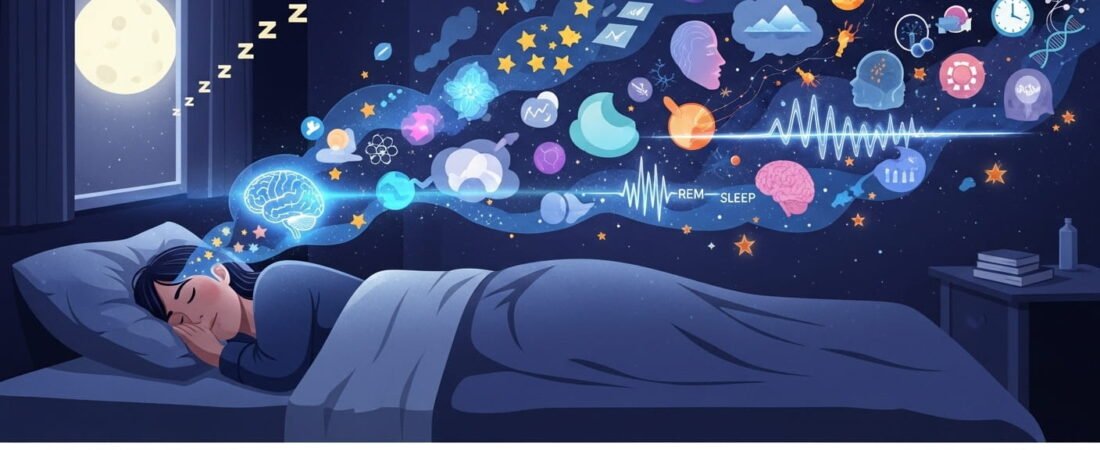
Science has been trying to answer this question for decades. With the help of psychology, neuroscience, and sleep research, scientists have moved beyond myths and superstitions to understand what actually happens inside our brain when we dream. Today, we know that dreaming is closely connected to sleep, especially a stage called REM (Rapid Eye Movement) sleep. During this stage, the brain is highly active, almost as active as when we are awake, even though our body is resting. This brain activity creates images, emotions, sounds, and stories that we experience as dreams.
One major scientific explanation is that dreams help the brain process memories and emotions. Throughout the day, our brain receives a huge amount of information—things we see, hear, learn, and feel. While we sleep, the brain sorts through this information, keeping what is important and letting go of what is not. Dreams may be a result of this process. That is why many dreams are connected to recent events, worries, or strong emotions from our daily life.
Another important theory suggests that dreaming plays a role in emotional balance and mental health. Dreams allow us to safely experience emotions like fear, happiness, anger, or sadness without real-world consequences. By doing this, the brain may be helping us cope better with stress and emotional challenges when we are awake. Some scientists also believe that dreams help us practice problem-solving and prepare for real-life situations.
Dreams are also linked to creativity and imagination. Many artists, writers, and scientists have reported getting ideas or inspiration from their dreams. This suggests that dreaming allows the brain to make new and unusual connections that are harder to make during waking hours.
Although science has made great progress, dreaming is still not fully understood. There is no single explanation that answers everything. Instead, dreaming appears to serve multiple purposes, from memory processing and emotional healing to creativity and brain development.
In this introduction, exploring why we dream through the lens of science helps us appreciate that dreams are not random or meaningless. They are a natural and important function of the human brain, offering valuable insights into how our mind works—even when we are asleep.
The Science Behind Dreaming: Understanding the Purpose of Dreams
To understand why we dream, it is important to first understand how sleep works. Sleep is not a single, uniform state but a cycle made up of different stages. These stages are divided into non-REM (NREM) sleep and REM (Rapid Eye Movement) sleep. Dreaming can occur in all stages of sleep, but the most vivid and memorable dreams usually happen during REM sleep. During this phase, brain activity increases, heart rate becomes irregular, and the eyes move rapidly beneath closed eyelids. Interestingly, while the brain is active, the muscles of the body are temporarily paralyzed. This prevents us from physically acting out our dreams and protects us from injury.
One of the strongest scientific explanations for dreaming is the memory consolidation theory. Throughout the day, our brain collects a large amount of information, including facts, experiences, and emotions. During sleep, especially REM sleep, the brain works to organize and store these memories. Dreams are thought to reflect this process. This is why elements from daily life often appear in our dreams, although they may be mixed, exaggerated, or presented in unusual ways. Studies have shown that people who get enough REM sleep tend to have better memory retention and learning ability, suggesting that dreaming plays a key role in strengthening memory.
Another widely accepted explanation focuses on emotional processing. The brain areas involved in emotions, such as the amygdala and limbic system, are highly active during REM sleep. At the same time, the prefrontal cortex, which controls logic and decision-making, becomes less active. This imbalance explains why dreams often feel emotional and illogical. By replaying emotional experiences in a dream-like environment, the brain may be helping individuals process feelings such as fear, anxiety, joy, or sadness. This emotional processing can reduce stress and help maintain mental well-being. People who are under emotional stress or experiencing major life changes often report more intense and frequent dreams.
Dreaming is also closely connected to problem-solving and learning. Some researchers believe that dreams allow the brain to explore different possibilities and solutions without real-world risks. While dreaming, the mind can freely combine ideas, memories, and concepts. This may explain why people sometimes wake up with solutions to problems or creative ideas that seemed difficult to solve while awake. Historical examples support this theory, as many scientists and artists, including inventors and writers, have credited dreams for their breakthroughs. In this way, dreams may act as a mental playground where the brain tests new ideas.
Another important theory is the threat simulation theory, which suggests that dreams evolved as a survival mechanism. According to this idea, dreams allow humans to rehearse dangerous or challenging situations, such as being chased or facing conflict. By simulating threats in a safe environment, the brain helps individuals prepare for similar situations in real life. This could explain why many common dreams involve fear, danger, or stress. Even though modern life is less physically dangerous than in the past, the brain may still use dreams to practice emotional and social survival skills.
Dreams also play a role in brain development, especially in infants and children. Babies spend a large portion of their sleep time in REM sleep, even more than adults. Scientists believe this high level of dreaming helps in the growth and development of the brain. During early life, dreams may support the formation of neural connections and help the brain adapt to new experiences. As people age, the amount of REM sleep decreases, which may explain changes in dream frequency and intensity over time.
Another scientific perspective comes from the activation-synthesis theory. According to this theory, dreams are the brain’s attempt to make sense of random neural signals that occur during sleep. During REM sleep, the brainstem sends signals to different parts of the brain, activating memories, emotions, and sensations. The brain then tries to organize these signals into a story, which we experience as a dream. This theory suggests that dreams do not have a hidden meaning but are a byproduct of brain activity. However, even if dreams are created from random signals, the content is still influenced by personal memories and experiences.
Lucid dreaming adds another interesting dimension to the science of dreaming. In lucid dreams, individuals become aware that they are dreaming and may even control parts of the dream. Research shows that lucid dreaming involves increased activity in the prefrontal cortex, the area responsible for self-awareness. This state demonstrates that the dreaming brain is flexible and capable of higher-level thinking, even during sleep. Studying lucid dreaming helps scientists better understand consciousness and the boundaries between sleep and wakefulness.
Nightmares and recurring dreams also provide insight into why we dream. Nightmares often occur during periods of stress, trauma, or anxiety. From a scientific point of view, nightmares may be the brain’s attempt to process overwhelming emotions or unresolved fears. Recurring dreams, on the other hand, may reflect ongoing conflicts or concerns in a person’s life. These patterns suggest that dreaming is closely tied to emotional health and psychological experiences.
Although scientists continue to debate the exact purpose of dreams, most agree that dreaming is not meaningless. Whether dreams help with memory, emotional healing, creativity, survival, or brain development, they appear to be an essential function of the human mind. Advances in brain imaging and sleep research continue to provide new insights, bringing us closer to understanding this fascinating phenomenon.
In conclusion, the body of scientific research suggests that dreams serve multiple important functions rather than a single purpose. They reflect the brain’s incredible ability to process information, regulate emotions, and adapt to challenges—even while we sleep. By studying dreams, science not only helps us understand sleep better but also reveals deeper truths about how the human brain works.
Conclusion
Dreaming remains one of the most fascinating and complex experiences of the human mind. While we may never remember every dream we have, science makes it clear that dreaming is far from a meaningless or random activity. Instead, it is deeply connected to how our brain functions, heals, learns, and grows. Through years of research in neuroscience and psychology, scientists have uncovered valuable insights that help explain why dreams occur and why they matter in our daily lives.
One of the most important conclusions drawn from scientific studies is that dreams play a vital role in memory and learning. As the brain sorts, stores, and strengthens information during sleep, dreams reflect this internal process. They help link new knowledge with past experiences, making learning more effective. This explains why good-quality sleep often leads to better focus, improved problem-solving skills, and stronger memory. Without adequate sleep and dreaming, the brain struggles to perform these essential functions.
Dreams are also crucial for emotional well-being. By allowing the brain to process emotions in a safe and controlled environment, dreams help reduce stress and emotional overload. They give the mind space to work through fears, worries, and unresolved feelings that may not be fully addressed during waking hours. Nightmares and emotional dreams, although uncomfortable, can still serve a purpose by highlighting inner conflicts or emotional needs that require attention.
Another key takeaway is the role of dreams in creativity and imagination. Dreams free the brain from logical boundaries, enabling unique combinations of ideas and thoughts. This creative freedom has inspired innovations, artistic expressions, and solutions to complex problems throughout history. In this way, dreams show that the sleeping brain is not inactive but highly imaginative and productive.
From an evolutionary and biological perspective, dreaming also supports survival and adaptation. Whether through practicing responses to threats or strengthening neural connections, dreams appear to help humans prepare for real-life challenges. This is especially evident in children, whose high levels of REM sleep contribute to brain development and learning during early life.
Although there are different theories—such as memory consolidation, emotional processing, threat simulation, and activation-synthesis—they do not contradict one another. Instead, they suggest that dreaming serves multiple purposes at the same time. Dreams are a reflection of the brain’s complexity and its ability to perform many tasks simultaneously, even during rest.
In conclusion, science explains dreaming as an essential and meaningful part of human life. Dreams help us understand ourselves better by revealing how our brain processes experiences, emotions, and ideas. While many mysteries still remain, ongoing research continues to bring us closer to fully understanding this remarkable phenomenon. Rather than ignoring dreams, recognizing their importance can deepen our appreciation of the human mind and the powerful work it performs—even while we sleep.
Top of Form