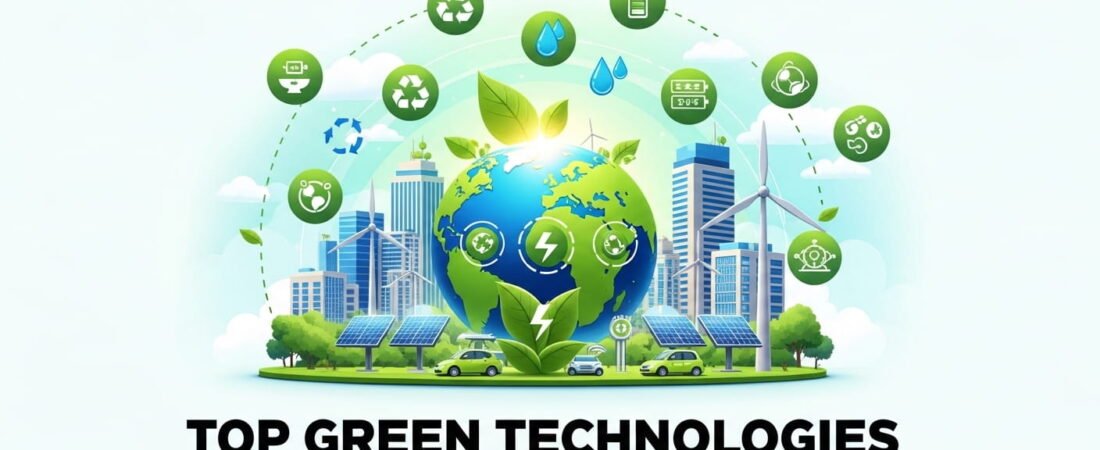
Introduction: Top Green Technologies
Top Green Technologies are driving a cleaner, smarter future by reducing emissions, conserving resources, and accelerating sustainable innovation worldwide.
When we talk about the future, one word consistently stands out — sustainability. Over the last decade, climate change, rising carbon emissions, and environmental degradation have forced governments, businesses, and individuals to rethink growth models. But what truly excites me is how technology is stepping up as a solution.
Green technology is no longer a niche concept. It is becoming mainstream, strategic, and economically powerful. From renewable energy innovations to electric mobility and smart grids, sustainable technology trends are redefining industries. As someone deeply interested in digital transformation and global developments, I see green innovation not just as an environmental necessity, but as an economic revolution.
The world is transitioning from traditional, carbon-heavy systems to clean, energy-efficient ecosystems. Countries are investing heavily in renewable infrastructure, corporations are prioritizing ESG goals, and startups are building climate-tech solutions that were unimaginable a decade ago.
In this article, I will explore the Top Green Technologies Changing the World and how these sustainable innovations are shaping our economy, careers, and everyday lives
1. Solar Energy Advancements
Solar technology has evolved significantly in recent years. Companies like Tesla are not just producing electric vehicles but also developing advanced solar roofs and battery storage systems.
Modern solar panels are now more efficient, affordable, and adaptable. Innovations like perovskite solar cells are increasing energy conversion rates, making solar power more accessible to households and industries.
Solar energy reduces dependency on fossil fuels and lowers electricity costs in the long run. With many countries aiming for net-zero emissions, solar power is becoming one of the strongest pillars of clean energy technology.
2. Wind Energy and Offshore Wind Farms
Wind energy continues to expand globally, especially offshore wind farms. Countries in Europe and Asia are heavily investing in large-scale wind projects to reduce carbon emissions.
Organizations such as the International Renewable Energy Agency emphasize wind power as a key contributor to global energy transition.
Advanced turbine designs now generate more power with less wind, improving efficiency and reducing land usage. Offshore wind farms also minimize environmental disruption compared to traditional energy plants.
3. Green Hydrogen Technology
Green hydrogen is emerging as a revolutionary clean fuel. Produced using renewable energy sources, it emits zero carbon during combustion.
Governments in countries like Germany and Japan are investing billions into hydrogen infrastructure.
Green hydrogen can decarbonize heavy industries like steel manufacturing, shipping, and aviation — sectors that are traditionally hard to electrify. This makes it one of the most promising climate change solutions of this decade.
4. Electric Vehicles (EVs)
Electric vehicles are rapidly replacing internal combustion engine cars. Companies such as BYD and Tesla are driving innovation in battery efficiency and range.
EV adoption reduces greenhouse gas emissions and dependence on fossil fuels. Governments are offering incentives and building charging infrastructure to accelerate this transition.
Battery recycling and solid-state battery development are further enhancing the sustainability of electric mobility.
5. Carbon Capture and Storage (CCS)
Carbon capture technology captures carbon dioxide emissions from industrial processes and stores them underground to prevent atmospheric release.
Major energy companies and climate-focused startups are investing in direct air capture systems. Even organizations like the United Nations recognize carbon capture as a supplementary tool for achieving climate goals.
Although not a complete solution, CCS plays a critical role in reducing emissions from unavoidable industrial activities.
6. Smart Grids and Energy Storage
Traditional power grids are being replaced by smart grids that optimize electricity distribution through AI and real-time monitoring.
Battery storage solutions allow renewable energy to be stored and used during peak demand. Companies like Siemens are developing intelligent grid infrastructure.
Smart grids improve efficiency, reduce power outages, and integrate renewable energy sources seamlessly into national systems.
7. Sustainable Agriculture Technologies
Agriculture is another sector experiencing green transformation. Precision farming uses AI, IoT sensors, and data analytics to reduce water and fertilizer waste.
Vertical farming and hydroponics minimize land usage and increase crop yield. Sustainable agriculture not only reduces environmental impact but also ensures food security for growing populations.
Technology-driven farming is particularly important for countries facing water scarcity and climate variability.
8. Biodegradable and Sustainable Materials
Plastic pollution has become a global crisis. Green innovation is now focused on biodegradable materials and sustainable packaging.
Startups are developing plant-based plastics and compostable alternatives. Many global brands are shifting to eco-friendly packaging to meet consumer demand and environmental regulations.
This shift reduces landfill waste and ocean pollution significantly.
9. Energy-Efficient Buildings
Green architecture and smart buildings are redefining urban development. Energy-efficient construction materials, solar-integrated rooftops, and automated climate control systems reduce electricity consumption.
Green-certified buildings not only lower emissions but also reduce long-term operational costs. Sustainable real estate is becoming a major investment trend worldwide.
Urban planning is increasingly focused on sustainability, water conservation, and waste management systems.
10. Circular Economy Technologies
The circular economy promotes reuse, recycling, and resource optimization instead of traditional “take-make-dispose” models.
Digital platforms are enabling product lifecycle tracking and waste reduction. Companies are designing products that are easier to recycle and refurbish.
This approach minimizes environmental impact and creates new economic opportunities through resource efficiency.
The Bigger Picture of Green Innovation
Green technologies are not just environmental solutions — they are economic drivers. They are creating jobs, attracting investments, and redefining global competitiveness.
As someone deeply involved in analyzing digital and global trends, I strongly believe that sustainability will be one of the most powerful career and business drivers of the next decade. Clean energy, sustainable innovation, and climate tech are no longer optional sectors — they are foundational industries shaping the future.
Understanding these green technologies helps us see beyond headlines. It allows us to recognize where opportunities lie — whether in clean energy startups, ESG-focused businesses, sustainable marketing strategies, or green finance.
The world is transitioning, and green technology is leading that transformation.
Conclusion
Green technologies transforming the world are not just about protecting the environment—they signal a deeper shift in how economies grow, industries operate, and people make choices. Sustainability has moved beyond being an optional initiative; it is now the backbone of long-term global development.
From renewable energy and green hydrogen to electric mobility, smart grids, and circular economy models, these innovations reflect a fundamental mindset change. Growth is no longer driven purely by consumption but guided by responsibility, efficiency, and long-term impact.
One global pattern is increasingly clear: green innovation is directly linked to economic competitiveness. Nations investing in clean energy and climate technology are building resilient, future-ready economies. Sustainable infrastructure attracts capital, ESG-aligned businesses earn trust, and climate-conscious companies gain stronger positions in global markets.
What makes this phase especially important is the speed of adoption. Governments are tightening carbon targets, corporations are embedding sustainability into core strategies, consumers are choosing eco-conscious brands, and startups are scaling climate-tech solutions at an unprecedented pace.
For professionals and students, this shift opens powerful opportunities. Careers in renewable energy, sustainable finance, green marketing, climate analytics, and environmental policy are expanding rapidly. Even digital and content professionals must now understand sustainability narratives, ESG reporting, and green branding—making sustainability communication a critical skill.
Green technology is also evolving through integration with AI, IoT, blockchain, and data analytics. This convergence is turning sustainability into something measurable, scalable, and commercially viable.
Ultimately, green technologies represent hope backed by responsibility. They prove that innovation and ethics can coexist—and that economic progress does not have to come at the cost of the planet. Sustainability is not a passing trend; it is the framework shaping the future of global growth.
The world is changing—and green innovation is leading the way.
Disclaimer
This article is for informational and educational purposes only. The technologies discussed reflect current global trends and ongoing developments in sustainable innovation. Technological adoption rates, government policies, and investment trends may vary by country and over time. Readers are encouraged to conduct independent research or consult industry professionals before making business, financial, or career decisions related to green technologies.
Read More https://readnews.in/top-10-global-events-that-are-shaping-2026/