

By Chandra Mohan | ReadNews.in
India’s fisheries and aquaculture sector has emerged as an important contributor to food security, rural livelihoods and economic development. From freshwater ponds and reservoirs to organised aquaculture farms, fish production supports millions of people across the country. Over the years, improvements in infrastructure, government support and farming practices have helped India strengthen its position among the world’s leading fish-producing nations.
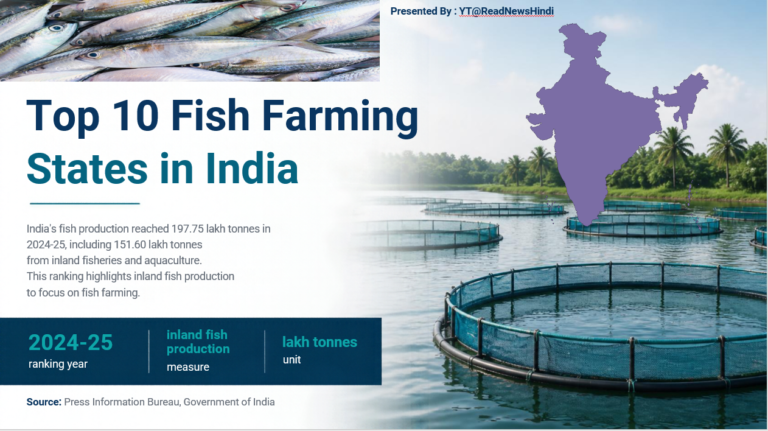
According to the Government of India’s Press Information Bureau (PIB), India’s total fish production reached 197.75 lakh tonnes in 2024-25, compared with 95.79 lakh tonnes in 2013-14. Inland fisheries and aquaculture accounted for 151.60 lakh tonnes, registering a reported increase of approximately 147% over the same period.
But which states contribute the most to India’s inland fish production? Andhra Pradesh occupies the leading position, followed by West Bengal and Uttar Pradesh. Other states, including Bihar, Odisha, Chhattisgarh, Assam, Telangana, Madhya Pradesh and Karnataka, also feature among the top ten.
ReadNews.in examines these ten states using official state-wise inland fish production figures for 2024-25. The ranking focuses on inland production rather than total fish production, which also includes marine catches.
Top 10 Fish Farming States in India
10. Karnataka — 4.37 Lakh Tonnes
Karnataka ranks tenth among India’s leading states for inland fish production, recording 4.37 lakh tonnes in 2024-25. The state has diverse aquatic resources, including rivers, reservoirs, lakes and freshwater farming areas that contribute to its fisheries sector.
Inland fish farming offers opportunities for farmers and rural entrepreneurs to diversify their agricultural activities. Fish cultivation can complement other forms of farming when water availability, suitable species, feed management and market access are carefully considered.
Karnataka also recorded 5.26 lakh tonnes of marine fish production, taking its total fish production to 9.63 lakh tonnes. This distinction is important because the state’s overall fisheries output is considerably higher than its inland production alone.
9. Madhya Pradesh — 4.45 Lakh Tonnes
Madhya Pradesh produced 4.45 lakh tonnes of inland fish in 2024-25, placing it ninth in this ranking. Its production was slightly higher than Karnataka’s inland output.
The state’s inland fisheries sector draws on freshwater resources, including reservoirs and other water bodies. These resources can support aquaculture development, fish cultivation and related livelihood opportunities, although productivity depends on local conditions and management practices.
For farmers, fish farming can provide an additional income stream alongside conventional agriculture. However, commercial success requires appropriate stocking densities, reliable fingerling supplies, water-quality monitoring, disease prevention and access to buyers.
Madhya Pradesh’s figures underline the contribution of inland fisheries to India’s wider agricultural economy.
8. Telangana — 4.77 Lakh Tonnes
Telangana recorded 4.77 lakh tonnes of inland fish production in 2024-25, securing eighth place. Its output exceeded that of Karnataka and Madhya Pradesh in the official inland production figures.
The state has freshwater resources that can support fish production, including reservoirs and tanks. Such water bodies can contribute to fisheries-based livelihoods and create opportunities for fishers, farmers, traders and other participants in the supply chain.
Expanding sustainable production requires more than access to water. Farmers also need suitable fish seed, scientific feeding practices, technical guidance, disease management and dependable transport arrangements.
Telangana’s position demonstrates the contribution of inland fisheries across India’s diverse agricultural regions.
7. Assam — 5.29 Lakh Tonnes
Assam ranks seventh, with inland fish production of 5.29 lakh tonnes in 2024-25. Unlike states whose fisheries include substantial marine production, Assam’s reported output in the PIB table is entirely inland.
The state’s rivers, wetlands, ponds and other freshwater resources form an important part of its fisheries landscape. Fish is also an established component of food habits in Assam, making production and market access particularly relevant to local consumers and livelihoods.
Developing the sector sustainably involves maintaining aquatic ecosystems while improving farm productivity. Flood-related risks, water management, quality fish seed and post-harvest handling are among the practical considerations for inland fisheries in the region.
Assam’s seventh-place ranking highlights the significance of freshwater production in northeastern India.
6. Chhattisgarh — 8.73 Lakh Tonnes
Chhattisgarh produced 8.73 lakh tonnes of inland fish in 2024-25, placing sixth in the national ranking. Its production was substantially higher than that of Assam and Telangana.
Freshwater aquaculture can provide additional economic opportunities in regions where suitable ponds, reservoirs and other water resources are available. For rural households, fish farming can complement agricultural activities and support employment in harvesting, transportation, processing and retail.
Sustained development depends on sound farm planning, suitable species selection, efficient feed use and regular water-quality checks. Access to local markets and cold-chain facilities also matters because fresh fish requires careful handling after harvest.
Chhattisgarh’s production figures demonstrate how inland fisheries contribute to economic activity beyond India’s traditionally recognised coastal centres.
5. Odisha — 9.53 Lakh Tonnes
Odisha ranks fifth in inland fish production, recording 9.53 lakh tonnes in 2024-25. Its total fish production was considerably higher, reaching 11.92 lakh tonnes when marine production was included.
The state has both inland and coastal fisheries, giving its fisheries economy a diverse production base. Inland output includes fish produced through freshwater systems and aquaculture, while marine production reflects a separate component of the sector.
This distinction matters when assessing the performance of fish farming. A state’s total production may reflect both cultivated inland fish and catches from the sea, which are influenced by different production systems.
Odisha’s inland production places it among the country’s leading states. Continued progress depends on sustainable resource management, improved infrastructure, efficient marketing and measures to reduce losses between harvest and consumption.
4. Bihar — 9.60 Lakh Tonnes
Bihar produced 9.60 lakh tonnes of inland fish in 2024-25, taking fourth place. Its output was marginally higher than Odisha’s inland production and demonstrates the substantial role of freshwater fisheries in eastern India.
Fish farming can support rural incomes and strengthen local food supplies when production is matched with consumer demand. For farmers, the availability of suitable ponds, quality fingerlings, affordable feed and practical technical support can influence both productivity and profitability.
The development of fisheries also creates activity beyond the farm itself. Traders, transport operators, wholesalers and retailers all participate in bringing fish to consumers.
Bihar’s ranking illustrates why inland aquaculture deserves attention in agricultural planning. Improvements in production management, storage, transport and market connectivity can help farmers capture greater value from their harvests.
3. Uttar Pradesh — 13.31 Lakh Tonnes
Uttar Pradesh ranks third, with 13.31 lakh tonnes of inland fish production in 2024-25. Its output was significantly higher than Bihar’s, placing the state among India’s most important inland fish-producing regions.
The state’s large agricultural economy provides a broad setting for freshwater fisheries and aquaculture. Where suitable water resources and infrastructure are available, fish cultivation can diversify farm activities and create additional income opportunities.
Scaling production sustainably requires attention to water availability, stocking practices, feed efficiency, fish health and market demand. Farmers must also consider the costs of inputs and the prices they can realistically obtain when selling their harvests.
Uttar Pradesh’s third-place ranking reflects the scale of its contribution to inland fish production. Further development can strengthen rural enterprise and local supply chains when supported by responsible farming practices and efficient distribution.
2. West Bengal — 20.07 Lakh Tonnes
West Bengal ranks second, recording 20.07 lakh tonnes of inland fish production in 2024-25. Its total fish production reached 23.74 lakh tonnes after marine output was included.
The state’s strong association with fish consumption makes fisheries an important part of its food economy. Freshwater ponds and aquaculture systems contribute to production, while distribution networks connect fish farmers with markets and consumers.
West Bengal’s inland output is substantially higher than that of Uttar Pradesh, which ranks third. This gap highlights the concentration of production among the leading states.
Maintaining a strong fisheries sector requires attention to water quality, disease prevention, efficient feed use, cold storage and hygienic transportation. Better handling can reduce post-harvest losses and preserve product quality.
West Bengal’s second-place position confirms its importance in India’s inland fisheries landscape.
1. Andhra Pradesh — 48.88 Lakh Tonnes
Andhra Pradesh leads India’s inland fish production ranking with 48.88 lakh tonnes in 2024-25. Its output was more than double West Bengal’s inland production, making it the clear leader among the ten states examined.
The state is also a major contributor to India’s wider fisheries economy. According to the PIB figures, Andhra Pradesh produced an additional 6.51 lakh tonnes of marine fish, taking its total fish production to 55.39 lakh tonnes.
Its leading inland output underscores the importance of aquaculture and freshwater production systems to the state’s fisheries profile. Commercial success in this sector depends on factors such as suitable farming conditions, quality seed, feed management, technical expertise, infrastructure and access to domestic and export markets.
Andhra Pradesh’s first-place ranking highlights the scale of its contribution to India’s fish supply. Its experience also reinforces the importance of production systems that combine commercial viability with environmental responsibility and effective disease management.
What These Rankings Mean for India’s Fisheries Sector
The top ten states demonstrate that inland fish production is geographically diverse, although output is concentrated among a few leading producers. Andhra Pradesh’s 48.88 lakh tonnes stands well above West Bengal’s 20.07 lakh tonnes, while Uttar Pradesh occupies third place with 13.31 lakh tonnes.
These figures also show why inland and marine production must be distinguished. Odisha, Karnataka, West Bengal and Andhra Pradesh record marine output in addition to inland production. Comparing total production alone would therefore produce a different picture from a ranking focused specifically on inland fisheries and aquaculture.
The sector’s future will depend on sustainable water use, scientific farming, quality fish seed, affordable inputs, disease control and stronger market infrastructure. Cold chains, processing facilities and better transport can help reduce losses and improve returns for producers.
Government initiatives, including the Pradhan Mantri Matsya Sampada Yojana and the Fisheries and Aquaculture Infrastructure Development Fund, are part of India’s broader effort to strengthen fisheries infrastructure, productivity and value chains.
Conclusion
India’s inland fish production has expanded significantly, creating opportunities for farmers, rural businesses and consumers. Andhra Pradesh leads the 2024-25 ranking, followed by West Bengal and Uttar Pradesh, while seven other states complete the top ten.
The figures offer more than a league table: they highlight the importance of aquaculture to food supply, employment and rural development. With responsible water management, improved technology, reliable infrastructure and better market access, inland fisheries can continue to contribute to India’s agricultural growth. The priority should be to increase productivity without compromising the natural resources on which the sector depends.
Chandra Mohan: Summary & Insights
India recorded 151.60 lakh tonnes of inland fish production in 2024-25, within total fish production of 197.75 lakh tonnes. Andhra Pradesh led the inland ranking at 48.88 lakh tonnes, followed by West Bengal at 20.07 lakh tonnes and Uttar Pradesh at 13.31 lakh tonnes. Bihar, Odisha, Chhattisgarh, Assam, Telangana, Madhya Pradesh and Karnataka completed the top ten. These figures highlight the scale and geographical spread of inland fisheries across India. They also underline the need to distinguish aquaculture and inland production from marine catches when comparing states. Future growth will depend on scientific farm management, efficient use of water and feed, better fish health practices, improved cold-chain infrastructure and stronger market access. Sustainable development can help fisheries contribute to rural incomes, nutrition and employment while protecting aquatic ecosystems.
Disclaimer: Production figures are based on the Government of India’s PIB release for 2024-25. Rankings refer specifically to inland fish production, not total fish production. Figures and interpretations may be updated when new official data becomes available.