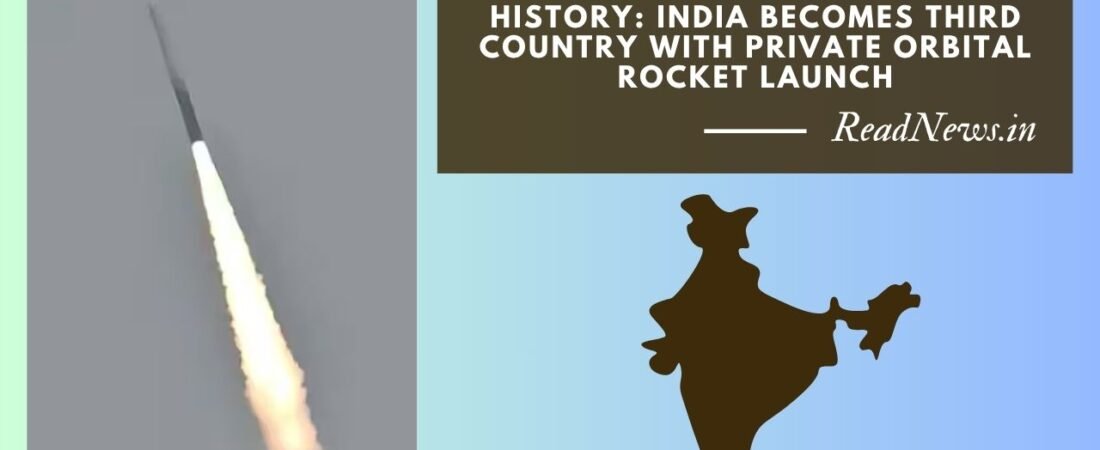


In the early hours of Saturday, July 18, 2026, India etched its name into the history of global spaceflight. Skyroot Aerospace, a private aerospace startup headquartered in Hyderabad, successfully launched its Vikram-1 rocket into a 450-kilometer low Earth orbit, making India only the third country in the world — after the United States and China — where a privately built and privately operated rocket has achieved orbital flight without direct involvement from a national space agency.
Until this launch, every orbital mission originating from Indian soil had been conducted by the Indian Space Research Organisation (ISRO), the government body that has anchored the country’s space ambitions since the 1960s. Skyroot’s success marks the first time a non-government Indian entity has carried payloads all the way into orbit, a milestone that shifts India’s space sector into a new, more commercially driven era.
The Launch: Mission Aagaman
The Vikram-1 rocket lifted off from the Satish Dhawan Space Centre in Sriharikota, Andhra Pradesh, at 2:35 a.m. Eastern Time (12:05 p.m. India time), following a brief hold-and-reschedule earlier in the countdown. Standing roughly 22 meters tall, the four-stage vehicle used three solid-fuel stages followed by a liquid-fuel orbital adjustment module to place its payloads precisely into low Earth orbit roughly 15 to 17 minutes after liftoff.
The mission was named “Aagaman,” a Sanskrit word meaning “the arrival,” and it lived up to its name. As telemetry confirmed successful orbital insertion, mission control erupted in celebration. The mission director declared the flight a “grand success,” a moment that Skyroot had been building toward since the company’s founding in 2018.
Vikram-1 is designed to carry payloads of up to 350 kilograms to low-inclination orbits, positioning it to compete in the fast-growing global small-satellite launch market currently dominated by players such as SpaceX, Rocket Lab, and a handful of Chinese commercial launch firms.
What Was On Board
Vikram-1’s debut flight carried a mix of commercial, scientific, and symbolic payloads. Several customer satellites and in-orbit experiments were included to validate the rocket’s propulsion, avionics, telemetry, guidance, navigation, and control systems under real flight conditions — data that will be essential for Skyroot’s future commercial missions. The rocket also carried Skyroot’s own SCOPE satellite, used to gather performance data from the flight itself.
Alongside the technical payloads, the mission carried two symbolic items that captured public attention: “Cosmic Bloom,” a floral-shaped artwork created using lab-grown gemstones, and a miniature 18-karat gold rocket bearing microscopic engravings honoring three towering figures in Indian science — Nobel laureate physicist C.V. Raman, space programme founder Vikram Sarabhai (after whom the rocket itself is named), and former President and aerospace scientist A.P.J. Abdul Kalam.
Perhaps the most personal touch came from the country’s top office: a handwritten postcard from Prime Minister Narendra Modi, inscribed with the words “Vande Mataram,” also flew aboard Vikram-1. Following the successful mission, Modi personally telephoned Skyroot’s founders to offer his congratulations, according to multiple reports.
From Suborbital Beginnings to Orbital History
Skyroot Aerospace’s journey to this moment began in June 2018, when the company was founded by Pawan Kumar Chandana and Naga Bharath Daka, both alumni of the Indian Institutes of Technology and former scientists at ISRO. The pair set out to build India’s first fully private launch vehicles at a time when the country’s space sector had only just begun opening its doors to private enterprise.
The company’s first major milestone came in November 2022, when its suborbital Vikram-S rocket became the first privately developed Indian launch vehicle to reach space. That mission, called “Prarambh” (meaning “the beginning”), was a proof-of-concept flight designed to validate technologies — including a novel all-carbon-fiber rocket structure and 3D-printed thrusters — that would later be scaled up for the orbital-class Vikram-1.
Getting from that suborbital test to Saturday’s full orbital success took years of stage testing, fundraising, and engineering refinement. Skyroot’s growth attracted significant investor interest along the way; the company became the first Indian space-sector firm to reach a $1 billion valuation earlier this year, reflecting growing global confidence in India’s private launch capabilities.
Why This Matters
India’s space sector was effectively a government monopoly for six decades. ISRO built its reputation on cost-efficient missions, including the Mangalyaan Mars orbiter and the Chandrayaan lunar missions, but private companies had no legal pathway to conduct independent launches until the sector was liberalized in 2020. Since then, a new generation of Indian space startups — including Skyroot, Agnikul Cosmos, and others — has been racing to translate that policy shift into flight hardware.
Skyroot’s orbital success is the clearest validation yet of that liberalization strategy. It signals that India’s private space industry has moved beyond government-subsidized experimentation and into genuine commercial capability — the same trajectory the United States followed with companies like SpaceX and Rocket Lab, and that China has pursued through firms such as iSpace and Galactic Energy.
The achievement also has strategic weight. Governments across Europe and Asia have been ramping up support for homegrown launch companies, driven by a desire for independent, sovereign access to space as both commercial satellite demand and defense-related space requirements accelerate. A successful private Indian launch provider adds another node to that increasingly multipolar launch landscape, and gives Indian and international satellite operators a new option beyond the incumbents.
For India specifically, having a credible private launch provider could ease the burden on ISRO, which has increasingly focused its own resources on deep-space missions, human spaceflight under the Gaganyaan programme, and strategic satellite launches. Commercial and small-satellite customers may now have a domestic private alternative for getting payloads into orbit, rather than relying solely on ISRO’s launch manifest or foreign providers.
The Road Ahead
Skyroot has stated that Vikram-1 is only the first of a planned family of vehicles. The company is also developing the larger Vikram-II and Vikram-III rockets, which are intended to carry heavier payloads and support multiple orbital insertions in a single mission — capabilities that would let Skyroot serve a wider range of satellite constellation customers, including companies building out mega-constellations for broadband and Earth observation.
Company officials have described Vikram-1’s design philosophy as emphasizing rapid turnaround, with the rocket reportedly built to be assembled and launched from any compatible site within 24 hours — a feature aimed squarely at the responsive-launch segment of the market, where customers value speed and flexibility as much as payload capacity.
With its maiden orbital flight now complete, Skyroot is expected to shift toward a more regular commercial launch cadence, competing for contracts from satellite operators worldwide who are looking to diversify away from a small number of dominant launch providers.
A New Chapter for Indian Spaceflight
For decades, “Indian rocket launch” was synonymous with ISRO. Saturday’s flight of Vikram-1 changes that equation. It does not replace ISRO’s role — the agency remains central to India’s most ambitious missions — but it does mark the arrival of a credible private alternative, built entirely by Indian engineers at an Indian company, launched from Indian soil.
As celebrations continued at Skyroot’s mission control and at its Infinity Campus in Hyderabad, one line from the company’s launch webcast commentary captured the moment best: “It is the dawn of a new space era.” For India’s private space industry — and for the broader global commercial launch market it is now entering — that assessment may prove prescient.
This article is based on publicly reported information as of July 19, 2026. Readers should verify mission details against official Skyroot Aerospace and Indian government statements for the most current updates.