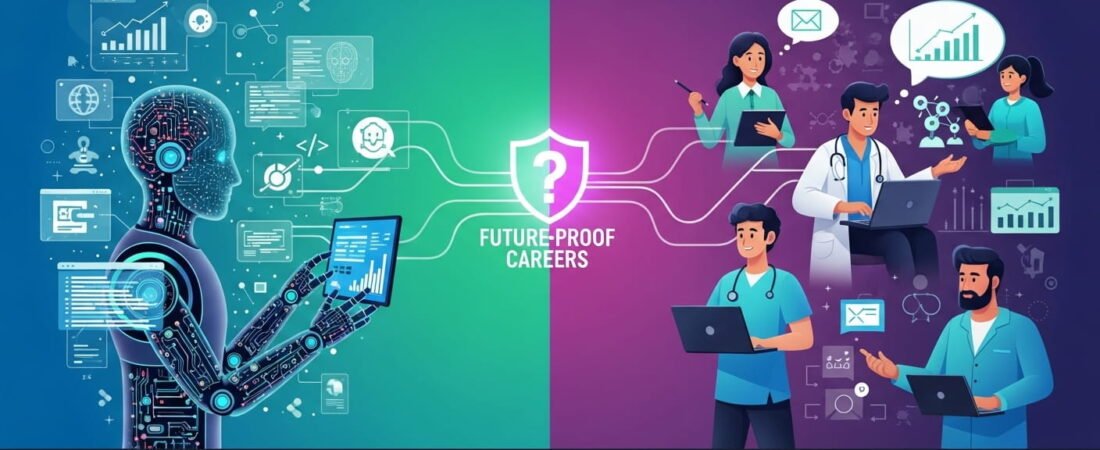


Introduction : AI vs Human Jobs
AI vs Human Jobs is a growing debate about whether technology will replace people or change the way we work in the future.
Artificial Intelligence is no longer a futuristic concept we read about in science fiction. It is already shaping industries, redefining workflows, and transforming how businesses operate. From AI-powered chatbots to automated data analysis systems, technology is moving at a pace that demands attention—not fear, but awareness.
As someone working in digital marketing and content strategy, I see this shift closely. Tools developed by organizations like OpenAI, Google, and Microsoft are rapidly enhancing productivity across industries. Content creation, SEO analysis, coding, design, customer support—many processes are now partially automated.
Naturally, this raises an important question:
Are human jobs at risk?
Students worry about choosing the wrong career path. Professionals fear redundancy. Even experienced managers are rethinking long-term strategies. The debate around AI vs Human Jobs is not about machines taking over tomorrow—it’s about understanding how work is evolving today.
However, after studying global employment reports, technological trends, and real-world digital transformations, I strongly believe that the conversation needs to shift from “job loss” to “job evolution.”
AI replaces tasks—not entire professions.
That distinction is critical.
In this article, I will break down:
- How AI is changing the job market
- Which jobs are most vulnerable
- Which careers are safest in the future
- The essential skills required in the AI era
- How students and professionals can future-proof themselves
Let’s approach this topic with clarity, logic, and practical insight—because fear never builds careers, but strategy does.
AI vs Human Jobs: Understanding the Real Shift
When we analyze AI’s impact on employment, we must first understand what AI does best.
AI excels at:
- Repetitive tasks
- Data processing at massive scale
- Pattern recognition
- Automation of structured processes
- Speed-based operations
Industries like banking, retail, logistics, customer service, and manufacturing are already integrating AI systems to increase efficiency and reduce costs.
For example:
- Automated chatbots handle basic customer queries.
- AI tools generate performance reports in seconds.
- Algorithms predict consumer behavior.
- Robotic systems manage warehouse operations.
But does this mean entire careers disappear?
Not necessarily.
Historically, technological revolutions—from the Industrial Revolution to the Internet boom—have eliminated certain jobs while creating entirely new industries. The same pattern is unfolding with AI.
The key difference is the speed of transformation.
Jobs Most Vulnerable to AI
To identify safe careers, we must first understand which roles face higher risk.
Jobs that are:
- Highly repetitive
- Rule-based
- Predictable
- Process-driven
- Data-entry focused
are more likely to be automated.
Examples include:
- Data entry operators
- Basic bookkeeping roles
- Telemarketing
- Routine customer support
- Basic manufacturing assembly jobs
AI systems can perform these tasks faster, with fewer errors, and at lower cost. This makes automation economically attractive for businesses.
However, even in these industries, complete elimination of human roles is rare. Instead, roles shift toward supervision, system management, and quality control.
Careers That Are Safer in the Future
Now comes the most important part.
Careers that require human depth are far more secure.
These include:
1. Healthcare Professionals
Doctors, nurses, therapists, and psychologists rely heavily on empathy, ethical judgment, and patient interaction. AI may assist in diagnosis, but human care remains irreplaceable.
2. Education & Training
Teachers, mentors, and trainers shape critical thinking and emotional development. AI tools can provide content, but guidance and personalized mentorship require human understanding.
3. Creative Strategy & Brand Building
AI can generate content drafts, but branding, storytelling, emotional messaging, and cultural sensitivity require contextual intelligence.
As a digital marketer, I’ve observed that AI tools support SEO and content generation—but campaign strategy, audience psychology, and brand positioning still depend on human expertise.
4. Leadership & Management Roles
Decision-making under uncertainty, crisis handling, and people management require emotional intelligence and ethical judgment.
5. Skilled Trades
Electricians, plumbers, mechanics, and field technicians perform complex physical tasks in unpredictable environments—areas where automation is still limited.
6. AI & Technology Specialists
Ironically, AI itself is creating demand for:
- AI developers
- Prompt engineers
- Data scientists
- AI ethics consultants
- Cybersecurity experts
The rise of AI expands the tech ecosystem rather than shrinking it.
Why Human Skills Matter More Than Job Titles
In my experience, focusing on job titles can be misleading. Instead, we should focus on transferable skills.
The safest professionals in the AI era will possess:
✔ Critical thinking
✔ Emotional intelligence
✔ Complex problem-solving
✔ Adaptability
✔ Communication skills
✔ Digital literacy
✔ Strategic decision-making
AI works on data. Humans work on meaning.
That difference defines career safety.
The Rise of Hybrid Careers
One major trend I see is the growth of hybrid professionals—individuals who combine domain knowledge with AI proficiency.
For example:
- Digital marketers who use AI for analytics
- Teachers who integrate AI learning platforms
- Doctors who leverage AI diagnostics
- HR professionals using AI-driven recruitment tools
The future does not reward resistance to technology. It rewards intelligent integration.
Instead of asking:
“Will AI replace me?”
We should ask:
“How can AI increase my productivity and value?”
That mindset shift is crucial.
AI and Employment Trends: What the Data Suggests
Global employment studies indicate that while automation may displace certain roles, it also creates new opportunities requiring advanced skills.
Organizations investing in AI are not simply reducing workforce numbers—they are restructuring roles.
Businesses need:
- AI supervisors
- Data analysts
- Ethical compliance officers
- Human-machine collaboration specialists
This means reskilling and upskilling are becoming essential career strategies.
How Students and Professionals Can Future-Proof Themselves
Based on my research and practical digital marketing experience, here are clear steps:
1. Develop Digital Awareness
Understand how AI tools work in your industry.
2. Focus on Human-Centric Skills
Communication, creativity, and empathy will always hold value.
3. Learn AI Tools Instead of Avoiding Them
Familiarity builds confidence.
4. Invest in Continuous Learning
Online certifications, workshops, and practical experience make you adaptable.
5. Build a Personal Brand
Professionals with visible expertise are harder to replace.
The Real Question: Fear or Preparation?
The AI revolution is neither entirely dangerous nor entirely safe. It is transformative.
History shows that those who adapt thrive.
As someone who bridges commerce, education, and digital marketing, I see enormous opportunity in this shift. The future belongs to professionals who combine intelligence with adaptability.
AI is powerful—but it lacks human consciousness, moral reasoning, and emotional depth.
And that is where our strength lies.
The workplace of tomorrow will not eliminate humans.
It will demand smarter, more skilled, and more adaptive humans.
The choice is not between AI or humans.
The real future is AI with humans.
And those who prepare today will lead tomorrow.
Conclusion
As someone deeply involved in digital marketing, content creation, and education, I’ve spent a significant amount of time studying how artificial intelligence is transforming industries. The debate around AI vs Human Jobs is no longer futuristic—it’s happening right now. From automated customer service chatbots to advanced AI-powered analytics tools, change is visible, measurable, and accelerating.
But here is what I strongly believe after analyzing trends, reports, and real-world shifts: the future is not AI replacing humans—it is AI reshaping human roles.
Technologies like OpenAI, Google, and Microsoft are building systems that can write, analyze data, generate code, and even create art. These developments may feel threatening at first glance. However, when we look deeper, we see a pattern—AI handles repetition, speed, and data-heavy tasks. Humans handle judgment, ethics, empathy, strategy, and creativity.
Careers that are most vulnerable are those heavily dependent on routine, predictable processes—basic data entry, repetitive manufacturing roles, and standardized reporting tasks. These jobs are process-driven, and AI excels in structured environments.
On the other hand, careers that require emotional intelligence, leadership, complex decision-making, adaptability, and human connection are far more resilient. Professions such as healthcare providers, educators, psychologists, strategic marketers, AI supervisors, UX designers, and creative directors are evolving—not disappearing.
In fact, AI is creating entirely new career paths:
- AI trainers and prompt engineers
- AI ethics specialists
- Automation consultants
- Human-AI workflow designers
- Data governance experts
As a digital marketing professional, I’ve seen how SEO, content marketing, and analytics are becoming AI-assisted rather than AI-replaced. Tools can generate drafts, analyze keywords, and automate reports—but strategy, brand positioning, storytelling, and emotional resonance still depend on human expertise.
The safest careers in the future will not be defined by job titles—but by skill sets.
Here are the skills that will protect careers:
- Critical Thinking
- Emotional Intelligence
- Adaptability
- Complex Problem-Solving
- Digital Literacy
- Strategic Communication
- Creativity with Context
The key question is not “Will AI take my job?”
The better question is: “How can I use AI to increase my value?”
Instead of resisting automation, professionals must integrate it. Learning how AI tools work, understanding their limitations, and using them responsibly can make individuals more productive and indispensable.
The future belongs to hybrid professionals—those who combine domain expertise with AI fluency.
As someone who bridges commerce, education, and digital marketing, I see enormous opportunity for people willing to upskill. The AI era is not about fear; it is about preparation. Continuous learning, digital awareness, and adaptability are the new job security.
If we focus on developing uniquely human strengths while leveraging AI as a partner, not a competitor, the future becomes less uncertain and more empowering.
The world of work is not shrinking—it is transforming.
And transformation always rewards those who evolve.
Disclaimer
This article is for informational and educational purposes only. Career trends and technological advancements are continuously evolving. While every effort has been made to ensure accuracy, readers are advised to conduct independent research and consult professional career advisors before making career-related decisions.
Read more https://readnews.in/virtual-reality-vs-augmented-reality-whats-better/