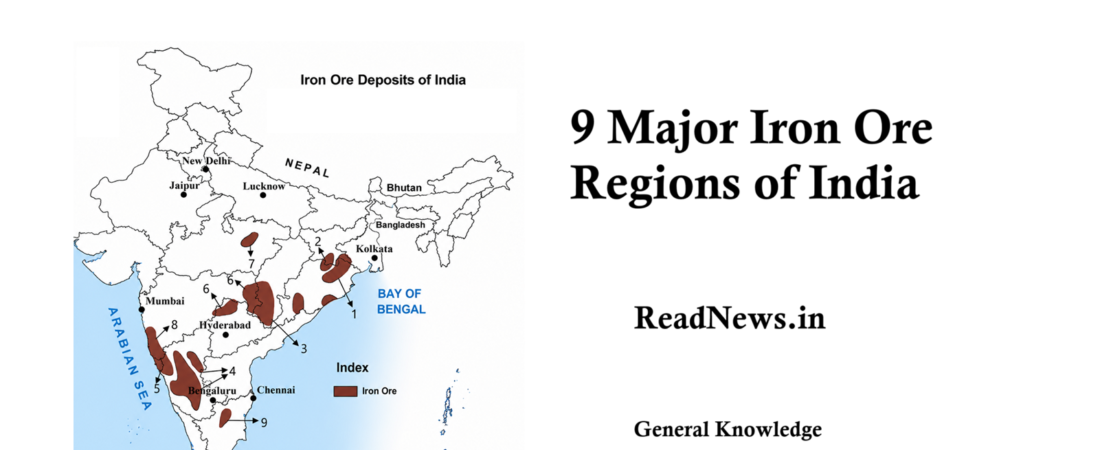


Here are details of 9 Major Iron Ore Regions of India for General Knowledge and Competitive Exams:
1. Odisha — Sundergarh, Kendujhar, Mayurbhanj & Cuttack
Odisha is one of India’s most important iron-ore regions. Major deposits occur across Sundergarh, Kendujhar, Mayurbhanj and Cuttack. Important mining areas include Bonai, Kiruburu, Badampahar and Gurumahisani. The region contains substantial high-grade hematite associated with banded iron formations, making it a major base for India’s steel industry.
2. Jharkhand — East & West Singhbhum
The Singhbhum region of Jharkhand contains some of India’s oldest and most significant iron-ore deposits. Major mining locations include Noamundi and Gua. The deposits are predominantly associated with banded iron formations and include high-quality hematite. Iron ore from this region has historically supported major steel-producing centres in eastern India.
3. Chhattisgarh — Bastar & Durg
Chhattisgarh has major iron-ore deposits in Bastar and Durg. The famous Bailadila range in Bastar contains high-grade hematite, while Dalli-Rajhara in Durg is another important mining area. These deposits have played a major role in supplying raw material to steel plants and supporting the development of central India’s mineral-based industries.
4. Karnataka — Bellary, Hospet & Chikmagalur
Karnataka is a major iron-ore region, particularly around the Ballari-Hospet sector. Important deposits are also found in the Baba Budan Hills and Chikmagalur region. The ores include hematite and magnetite. The Ballari-Hospet deposits have historically been among India’s richest iron-ore areas and remain closely associated with the state’s steel industry.
5. Goa — North & South Goa
Goa forms an important western coastal iron-ore region along with parts of Maharashtra. Its deposits are generally associated with lower-grade ores compared with some eastern Indian deposits, but they have been commercially significant because of Goa’s proximity to ports. Iron ore from the region has historically supported substantial export-oriented mining activity.
6. Telangana — Adilabad
The map identifies Adilabad in Telangana as an iron-ore deposit region. Telangana has iron-ore occurrences in several areas, with Adilabad being one of the historically recognized locations. Other Telangana regions associated with iron ore include Karimnagar and Warangal. These deposits contribute to the state’s broader mineral-resource base.
7. Madhya Pradesh — Jabalpur & Sarguja
The map identifies Jabalpur and Sarguja as part of this iron-ore distribution zone. Jabalpur has documented iron-ore occurrences, while the historical reference to Sarguja reflects the regional geological distribution shown in the source map. Because administrative boundaries have changed, Sarguja is now associated with Chhattisgarh rather than Madhya Pradesh.
8. Maharashtra — Chandrapur & Ratnagiri
Maharashtra has important iron-ore occurrences in districts including Chandrapur and Ratnagiri. These areas form part of western and central India’s broader iron-ore distribution. Chandrapur is associated with the Durg-Bastar-Chandrapur mineral belt, while Ratnagiri belongs to the Maharashtra-Goa belt, where iron ore has historically been commercially exploited.
9. Tamil Nadu — Salem & Tiruchirappalli
Tamil Nadu contains iron-ore occurrences particularly around Salem and Tiruchirappalli, as shown in the historical map. Salem is recognized as an important iron-ore region in the state. Tamil Nadu’s deposits are smaller compared with major eastern and central belts, but they form part of India’s wider distribution of iron-bearing geological formations.