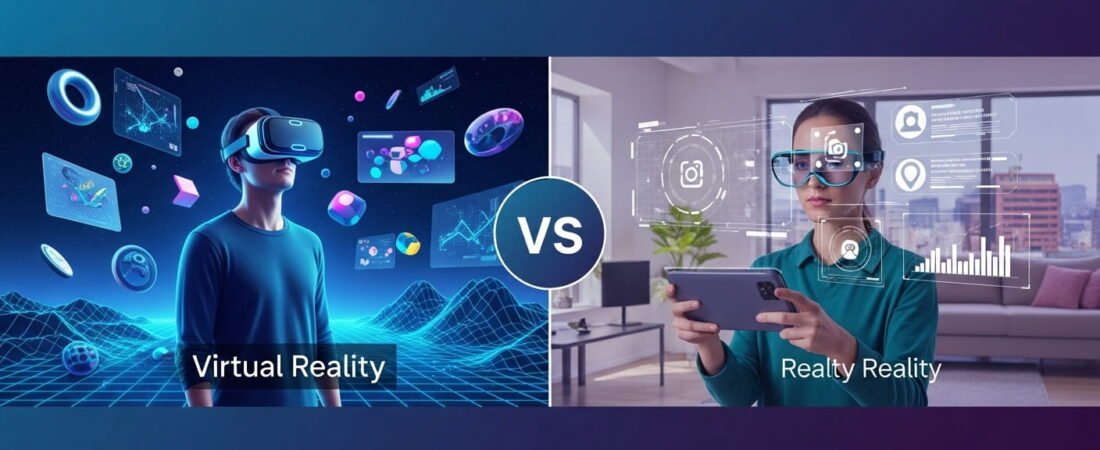
The rapid evolution of digital technologies has fundamentally altered how humans perceive, interpret, and interact with reality. Among the most discussed immersive technologies today are Virtual Reality (VR) and Augmented Reality (AR). While both are often grouped together under the umbrella of “extended reality,” their purposes, social implications, and real-world applications differ significantly. Understanding these differences is essential, not only from a technological standpoint but also from a sociological and civic perspective, as these tools increasingly shape education, work, governance, and cultural behavior.
Understanding Virtual Reality
Virtual Reality refers to a fully immersive digital environment that replaces the physical world with a computer-generated one. By wearing VR headsets, users are transported into simulated spaces where they can interact with objects and environments that may or may not resemble real life. This experience is typically isolating in nature, as it disconnects users from their immediate physical surroundings.
From a sociological lens, VR represents an escape-based technology. It creates alternate realities that allow individuals to temporarily detach from social constraints such as geography, physical ability, or even economic limitations. In sectors like gaming and entertainment, VR offers deep immersion and emotional engagement. In education and training, it enables risk-free simulations—such as medical surgeries, military drills, or industrial operations—where mistakes do not result in real-world consequences.
However, the immersive nature of VR raises important social questions. Prolonged use can reduce real-world social interaction and may encourage withdrawal from physical communities. There are also concerns related to mental health, particularly among younger users, where the boundary between simulated and actual experiences can become blurred. From a civic standpoint, this raises debates around regulation, ethical design, and responsible usage.
Understanding Augmented Reality
Augmented Reality, in contrast, enhances the real world rather than replacing it. AR overlays digital information—such as images, text, or animations—onto physical environments, typically through smartphones, tablets, or smart glasses. Users remain grounded in their physical surroundings while interacting with digital elements.
AR aligns more closely with integration-based technology. Instead of pulling individuals away from society, it blends technology into everyday social life. Applications of AR are already visible in navigation systems, retail experiences, education, healthcare, and governance. For instance, AR can help students visualize historical monuments, assist technicians with real-time repair instructions, or enable citizens to access contextual civic information in public spaces.
From a sociological perspective, AR strengthens functional interaction with society. It supports productivity, accessibility, and inclusivity. For people with disabilities, AR can offer real-time assistance, translations, or visual cues. In education, it democratizes learning by making abstract concepts tangible. Unlike VR, AR does not demand isolation; it complements human presence and social interaction.
Educational Impact
Education is one of the most critical areas where the comparison between VR and AR becomes meaningful. VR excels in experiential learning. Students can virtually visit ancient civilizations, explore the human body from within, or simulate complex scientific experiments. This is particularly useful where physical access is limited due to cost, safety, or geography.
AR, however, offers continuity in learning environments. It allows students to remain in classrooms or real-world settings while accessing additional layers of information. A geography lesson can come alive with interactive maps overlaid on textbooks, while history lessons can project timelines and events onto classroom walls.
From an educational policy standpoint, AR is more scalable and cost-effective, especially in developing countries. VR infrastructure requires high-end hardware and controlled environments, whereas AR can function on widely available smartphones. This difference has implications for educational equity and access, making AR a more socially inclusive option.
Workplace and Economic Applications
In professional settings, VR is primarily used for training and simulation. Industries such as aviation, defense, healthcare, and manufacturing benefit from immersive training modules that reduce risk and improve preparedness. VR-based training can enhance muscle memory, decision-making skills, and situational awareness.
AR, on the other hand, is more suited for real-time assistance and productivity enhancement. Field workers can receive live instructions, architects can visualize structures on-site, and marketers can offer interactive customer experiences. AR directly integrates with workflows rather than creating separate training spaces.
From an economic sociology perspective, AR has a broader impact on employment patterns. It augments human labor instead of replacing it, potentially reducing fears of technological unemployment. VR, while powerful, is more specialized and limited to certain sectors.
Social Interaction and Culture
Social interaction in VR occurs through avatars in virtual spaces. While this opens new forms of identity expression and global connectivity, it also introduces challenges related to authenticity, accountability, and digital behavior. Issues such as virtual harassment, identity misrepresentation, and digital addiction are increasingly being debated in policy circles.
AR maintains social norms by anchoring interactions in physical reality. Cultural practices, public behavior, and civic engagement remain intact while being enhanced by information. For example, AR-based museum guides enrich cultural understanding without detaching visitors from shared physical spaces.
Culturally, AR supports collective experiences, whereas VR often emphasizes individual immersion. This distinction is significant in societies where community and shared spaces play a central role in social cohesion.
Governance, Ethics, and Accessibility
Both VR and AR raise ethical concerns, but their nature differs. VR demands strict content regulation, especially when used by children, due to its psychological impact. There are also privacy concerns related to data collected through eye tracking and behavioral monitoring.
AR presents challenges related to surveillance and data overlay in public spaces. The ability to access real-time information about locations, objects, or individuals raises questions about consent, privacy, and misuse. Governments and civic institutions must balance innovation with regulation to prevent misuse while encouraging beneficial applications.
In terms of accessibility, AR again holds an advantage. It is easier to deploy, more affordable, and adaptable to diverse social contexts. VR’s dependence on specialized equipment limits its reach, particularly in rural or economically weaker regions.
Technological Maturity and Future Trajectory
Currently, AR is more integrated into daily life, while VR remains more niche. Smartphones have accelerated AR adoption, whereas VR is still dependent on headsets that are not yet mainstream. This difference influences how societies adopt and normalize these technologies.
Looking at long-term societal impact, AR appears more aligned with sustainable technological integration. It supports gradual adaptation, skill enhancement, and informed citizenship. VR, while revolutionary, represents a more disruptive shift that requires careful social conditioning and regulation.
From a sociological and civic viewpoint, the question of “what’s better” cannot be answered purely in technical terms. It depends on context, purpose, and societal readiness. VR excels in controlled, immersive experiences, while AR strengthens real-world engagement and collective functionality. As these technologies continue to evolve, their influence on human behavior, institutions, and culture will remain a critical area of study and public discourse.
Conclusion
When viewed through a sociological and civic lens, the debate between Virtual Reality and Augmented Reality is less about technological superiority and more about social suitability. Both technologies reflect different human needs—VR caters to immersion and simulation, while AR supports enhancement and integration. Virtual Reality has immense value in specialized domains where controlled environments, experiential learning, and risk-free practice are essential. At the same time, its isolating nature and infrastructural demands make it a technology that requires cautious and regulated adoption.
Augmented Reality, on the other hand, aligns more naturally with everyday social life. By enhancing rather than replacing reality, it strengthens education, work, governance, and public engagement without disrupting existing social structures. Its accessibility, scalability, and inclusiveness make it particularly relevant for diverse societies and developing regions. As digital technologies increasingly influence human behavior and institutions, AR appears better positioned to support collective progress, informed citizenship, and sustainable integration of technology into daily life.
Ultimately, the question is not which technology is universally better, but which one serves society’s needs responsibly at a given time and context.
About the Author
Chandra Mohan is a sociologist with an M.A. in Sociology and over 15 years of academic and practical experience in the field. He has a strong understanding of current affairs, history, geography, and civics, which reflects in his analytical writing. As a contributor to ReadNews.in, he focuses on explaining contemporary issues through a social, educational, and public policy perspective, making complex topics accessible to a wider audience.