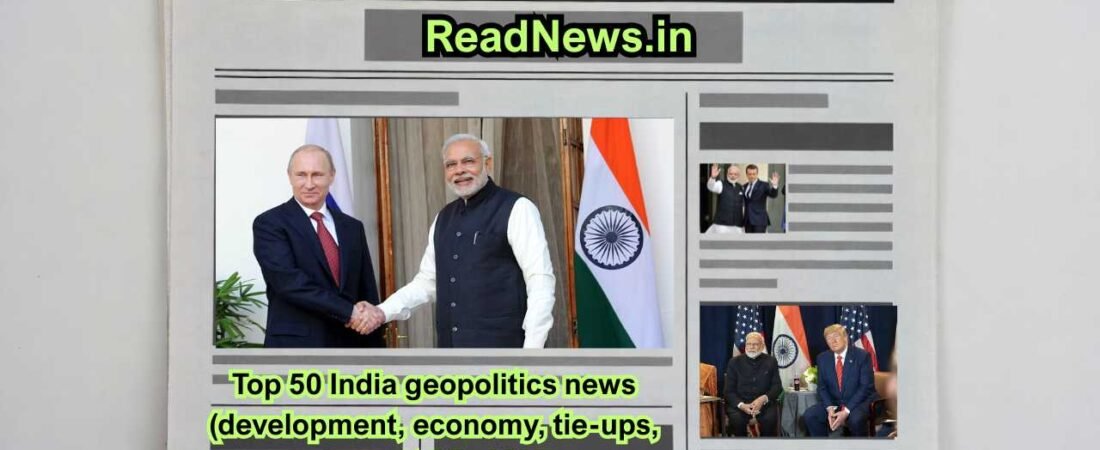
India’s geopolitical journey in 2025 has been defined not by conflict, but by collaboration, innovation, and strategic development. As one of the fastest-growing economies in the world, India has leveraged its demographic strength, technological advances, and diplomatic outreach to deepen partnerships across continents. From renewable energy and digital infrastructure to education, trade, and cultural diplomacy, the year has showcased India’s ability to balance domestic priorities with global responsibilities. Summits, bilateral agreements, and multilateral engagements have reinforced India’s role as a bridge between developed and emerging economies, while its focus on sustainable growth and inclusive development has positioned it as a trusted partner in shaping the future of global cooperation.
India–Russia unveil diversified economic roadmap
India and Russia shifted toward a more balanced, diversified economic partnership beyond defense and energy, unveiling a five-year roadmap to boost trade, address deficits, and explore joint ventures and EAEU FTA discussions. The partners set sights on a USD 100 billion trade target by 2030.
Putin–Modi engagement strengthens geoeconomic alignment
High-level India–Russia engagement emphasized geoeconomic tools—trade, supply chains, finance, and energy—to advance national interests. Discussions highlighted joint projects, nuclear partnerships, and regional coordination, underscoring a long-term, pragmatic economic alignment to stabilize growth and strategic autonomy for both countries.
Year-defining diplomatic visits and agreements
India’s 2025 diplomacy featured pivotal leader-level engagements and agreements at major forums, including SCO interactions and bilateral summits. These events underscored India’s role in regional architecture, economic connectivity, and multilateral coordination focused on trade, technology, and development outcomes rather than conflict.
India’s economy shows resilience amid global shocks
India ended 2025 among the fastest-growing economies, balancing growth and inflation while navigating tariff shocks and external pressures. Market highs, a volatile rupee, and expanding trade ties reflected a year of reform and recalibration—solidifying momentum toward becoming the world’s third-largest economy by 2030.
Digital public infrastructure outreach expands regionally
India deepened global dialogues on its digital public infrastructure model—identity, payments, and data empowerment—offering technical cooperation and capacity-building to partner countries. This outreach bolstered trusted digital ecosystems and inclusion-focused development, positioning India as a key knowledge partner in scalable public tech.
Semiconductor ecosystem commitments continue
Policy continuity and incentives attracted new expressions of interest in semiconductor design and assembly. India worked with global firms on supply-chain resilience and trusted manufacturing, aligning with partner standards to grow fabrication readiness, packaging capabilities, and talent pipelines for long-term tech sovereignty.
EV manufacturing clusters scale up
States accelerated EV and battery manufacturing clusters with vendor parks, skill programs, and export facilitation. International tie-ups focused on localized value chains, interoperable charging ecosystems, and recycling, advancing clean mobility ambitions while integrating India into global EV supply networks.
Renewable energy partnerships broaden
India expanded partnerships in solar, wind, and green hydrogen, aligning financing, standards, and project pipelines with international investors. Cross-border technology transfers and offtake agreements advanced grid stability and storage, underpinning India’s clean energy growth and industrial decarbonization.
Logistics and port modernization agreements
India pursued port upgrades, multimodal logistics corridors, and customs modernization with global partners. Tie-ups targeted faster throughput, greener operations, and digital tracking—supporting export competitiveness and resilient supply chains across Asia, Middle East, and Africa.
Space collaboration and commercial launch services
ISRO and private players engaged with partners on satellite services, earth observation applications, and commercial launches. Cooperation centered on climate monitoring, disaster management, and secure communications, strengthening India’s space economy and shared data ecosystems.
Pharma and biotech cooperation for global health
India’s pharma and biotech firms advanced regulatory harmonization and joint research frameworks with partner agencies. Efforts included vaccine platforms, affordable generics, and clinical collaboration—supporting global health security and equitable access.
Education and skilling exchanges
India expanded education partnerships, joint degree programs, and skill recognition pathways. Mobility agreements and industry-linked curricula improved employability, enabling talent exchanges in AI, cybersecurity, and advanced manufacturing.
Tourism and cultural diplomacy initiatives
Cultural festivals, film co-productions, and tourism promotions strengthened people-to-people ties. Streamlined visas and heritage circuits positioned India as a diversified destination, supporting local economies and soft power.
Smart city collaborations
India engaged global urban tech firms on smart mobility, water management, and energy efficiency. Pilot projects adopted interoperable data standards and public dashboards, improving city services and transparency.
Startup and VC bridges
India built cross-border startup bridges with accelerators and VC funds, enabling co-investments and market access. Focus areas included climate-tech, fintech, and health-tech, with regulatory sandboxes facilitating innovation.
Food security and agri-tech linkages
Agri-tech collaborations promoted precision farming, cold-chain logistics, and digital marketplaces. Partnerships addressed storage losses and export quality, strengthening food systems and rural incomes.
Financial services connectivity
India improved fintech interoperability and cross-border payments with partners, building on UPI-like models and regulatory dialogues. This supported remittances, MSME trade, and digital inclusion.
Cybersecurity cooperation frameworks
India enhanced cybersecurity partnerships on threat intelligence, incident response, and critical infrastructure protection. Public–private coordination improved resilience and standards alignment.
Climate finance and green bonds
India advanced access to climate finance, green bonds, and blended finance mechanisms with multilateral and bilateral partners. Projects targeted renewable energy, urban resilience, and industrial efficiency.
Supply-chain resilience pacts
India pursued friend-shoring and near-shoring tie-ups to diversify critical supply chains in electronics, pharma, and renewables. Agreements emphasized standards, traceability, and risk mitigation.
Colocation of data centers
International cloud and data center firms expanded in India, with agreements on renewable-powered facilities and data localization compliance, supporting a robust digital economy.
Pharma quality and GMP harmonization
India worked with regulators to harmonize GMP standards and inspection protocols, facilitating exports and trust in Indian pharma.
Textile and apparel value-chain cooperation
Tie-ups supported sustainable textiles, technical fabrics, and circularity. India positioned itself in premium value chains via compliance and innovation.
MSME export facilitation
India expanded MSME export schemes, trade portals, and e-commerce onboarding with partner support, improving access to global markets.
Urban transport and metro systems
International collaborations supported metro expansions, signaling upgrades, and transit-oriented development, reducing congestion and emissions.
Hydrogen corridors and pilots
India’s green hydrogen pilots advanced through international technology partnerships, focusing on electrolyzer manufacturing and industrial use-cases.
Critical minerals partnerships
India engaged in responsible sourcing and processing of lithium, cobalt, and rare earths through bilateral frameworks, supporting clean tech manufacturing.
Ocean economy initiatives
Blue economy tie-ups promoted sustainable fisheries, maritime research, and port-led development, balancing growth with conservation.
Battery recycling ecosystems
Partners collaborated with India on battery recycling standards, reverse logistics, and circular design for EVs and storage.
Rural broadband and 5G expansion
Telecom partnerships accelerated rural broadband and 5G rollout, enabling digital services for education, health, and commerce.
AI governance and ethics dialogues
India joined international forums on AI governance, focusing on safety, transparency, and inclusive innovation.
Agriculture export diversification
India negotiated market access for agri exports, aligning standards and traceability for spices, rice, fruits, and marine products.
Creative industries and gaming
Co-productions and gaming partnerships tapped global markets, with IP protection and content localization frameworks.
Skill mobility with recognition agreements
Mutual recognition of skills and certifications enabled smoother migration for professionals, supporting global talent pipelines.
Railway modernization cooperation
Tie-ups supported signaling, rolling stock upgrades, and logistics efficiency, strengthening domestic freight and passenger services.
Water security and sanitation projects
International support advanced urban water reuse, rural sanitation, and watershed management for climate resilience.
Healthcare delivery and telemedicine
Partnerships expanded telemedicine and digital health records, improving access and continuity of care.
Academic research consortia
Joint research programs in climate, materials, and life sciences grew with open-access data and shared infrastructure.
Women-led enterprise programs
Collaborations supported financing and market access for women-led MSMEs, improving livelihoods and inclusion.
E-commerce logistics optimization
Cross-border partnerships improved last-mile efficiency, returns processing, and sustainability in e-commerce operations.
Energy efficiency in industry
Technology transfers enabled advanced motors, process optimization, and waste heat recovery, cutting industrial emissions.
Tourism infrastructure PPPs
PPP models with global partners improved airports, convention centers, and eco-lodges, boosting hospitality quality.
Digital skilling for youth
Skill alliances offered micro-credentials and apprenticeship pathways in cloud, cybersecurity, and data analytics.
India–Russia trade recalibration review
Analysts noted India and Russia pursued trade diversification, addressing deficit and exploring new sectors, reflecting a pragmatic recalibration of economic ties in 2025.
Indian diplomacy year-in-review highlights
A comprehensive year-end review emphasized visits, agreements, and forum engagements that shaped India’s diplomatic and economic agenda, highlighting development-oriented outcomes across 2025.
India’s 2025 economy: reform and resilience
Media analyses captured India’s “Goldilocks” balance—strong growth with manageable inflation—despite external shocks, tariff changes, and currency pressures. Markets reflected confidence even as policy adjusted to global dynamics.
Eurasian Economic Union FTA exploration
Discussions progressed on an India–EAEU FTA to widen market access and diversify trade beyond traditional sectors, aligning with the goal of a broader, balanced economic engagement with Russia and Eurasian partners.
Geoeconomic framing of India–Russia ties
Commentary contextualized India–Russia cooperation as geoeconomics—using trade, finance, and supply chains to advance national interests—supporting strategic autonomy while deepening development-centric outcomes.
Conclusion
The year 2025 will be remembered as a turning point in India’s geopolitical narrative, where the emphasis shifted decisively toward development, economic resilience, and constructive global engagement. Unlike eras dominated by security concerns, this year highlighted India’s ability to harness diplomacy as a tool for growth, innovation, and sustainability. By prioritizing economic diversification, India strengthened its trade relationships with both traditional allies and new partners, ensuring that its growth trajectory remained robust despite global uncertainties. The pursuit of balanced trade agreements, particularly with Eurasian economies, demonstrated India’s pragmatic approach to reducing deficits and expanding market access, while simultaneously reinforcing its strategic autonomy.
Equally significant was India’s leadership in digital public infrastructure, which became a model for inclusive technological empowerment. By sharing expertise in identity systems, payment platforms, and data governance, India positioned itself as a global knowledge hub, enabling other nations to replicate scalable solutions for their own populations. This digital diplomacy not only enhanced India’s soft power but also created new avenues for economic cooperation in fintech, cybersecurity, and cross-border digital services.
The energy sector emerged as another cornerstone of India’s 2025 agenda. With ambitious targets in renewable energy, green hydrogen, and electric mobility, India expanded partnerships that aligned financing, technology transfer, and industrial collaboration. These initiatives underscored India’s commitment to climate action while simultaneously creating new industries and employment opportunities. The focus on critical minerals and battery recycling further highlighted India’s foresight in building resilient supply chains for the clean energy transition.
Education, healthcare, and cultural diplomacy also played pivotal roles in shaping India’s global image. Joint degree programs, skill mobility agreements, and telemedicine partnerships reflected India’s dedication to human capital development and equitable access to services. Meanwhile, cultural exchanges, tourism initiatives, and creative industry collaborations strengthened people-to-people ties, reinforcing India’s identity as a vibrant and inclusive society.
Perhaps most importantly, India’s diplomacy in 2025 demonstrated a consistent theme: the pursuit of geoeconomics as the foundation of international relations. By leveraging trade, finance, and technology, India advanced national interests without resorting to confrontation. This approach resonated globally, as nations sought stability and cooperation in an era marked by economic volatility and climate challenges. India’s ability to balance growth with responsibility, autonomy with partnership, and tradition with innovation positioned it as a credible leader in shaping the future of multilateralism.
In conclusion, India’s geopolitical story in 2025 is one of resilience, foresight, and constructive engagement. The nation has proven that development-oriented diplomacy can be as powerful as traditional security alliances, and that economic strength, technological innovation, and cultural inclusivity are the true pillars of global influence. As India continues its journey toward becoming the world’s third-largest economy, the lessons of 2025 will serve as a blueprint for how nations can thrive by embracing cooperation, sustainability, and shared prosperity.