Introduction
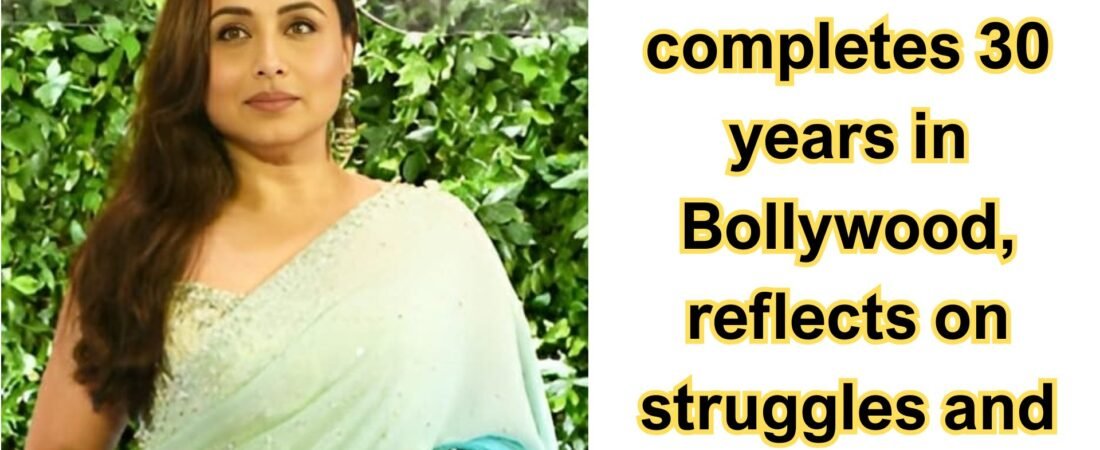
Rani Mukerji’s journey in Bollywood is a story of resilience, talent, and transformation. Completing 30 years in the film industry in 2026, she stands as one of the most versatile and respected actresses of Indian cinema. From her modest debut in 1996 to becoming a household name with iconic performances, Rani’s career reflects the evolution of Bollywood itself—shifting from traditional melodramas to socially conscious narratives. On this milestone, she shared her reflections on the challenges, triumphs, and lessons that shaped her path. Her words resonate not only with aspiring actors but also with anyone striving to carve a meaningful career in a competitive world.
Early Career and Struggles
Rani Mukerji’s entry into films was not accompanied by the glamour and certainty that many imagine. Her debut film Raja Ki Aayegi Baraat (1996) was modest in scale and did not immediately catapult her to stardom. Yet, it was her determination and natural screen presence that kept her moving forward. In the late 1990s, she began to gain recognition with films like Ghulam opposite Aamir Khan and Kuch Kuch Hota Hai with Shah Rukh Khan, where her portrayal of Tina left a lasting impression. These roles gave her visibility, but the road ahead was far from smooth. Rani herself has acknowledged that she faced skepticism about her voice, her appearance, and her ability to compete with established stars. Instead of succumbing to criticism, she used it as fuel to refine her craft. Every setback became a stepping stone, teaching her the importance of persistence and self-belief.
Her early years were marked by experimentation, where she accepted diverse roles without worrying about typecasting. This openness allowed her to explore different genres—from romantic dramas to thrillers—and gradually build a reputation as a dependable performer. The late 1990s were a testing ground, but they also laid the foundation for the powerhouse actress she would become in the following decade.
Rise to Stardom and Versatility
The 2000s marked Rani Mukerji’s golden era. Films like Saathiya (2002) showcased her ability to portray nuanced emotions, while Hum Tum (2004) highlighted her charm in romantic comedies. Her collaboration with Yash Raj Films proved pivotal, giving her opportunities to headline projects that balanced commercial appeal with artistic depth. One of her most acclaimed performances came in Black (2005), where she played a visually and hearing-impaired woman under the mentorship of Amitabh Bachchan’s character. The film was a critical triumph, earning her accolades and cementing her status as one of the finest actresses of her generation.
Rani’s versatility was evident in her ability to seamlessly transition between genres. In Veer-Zaara (2004), she played a strong supporting role that added gravitas to the narrative, while Bunty Aur Babli (2005) allowed her to revel in comedy and mischief. This adaptability made her a favorite among directors and audiences alike. She never relied solely on glamour; instead, she invested in characters that had depth and relatability.
Her success during this period was not accidental. Rani consciously chose roles that challenged her, refusing to be boxed into stereotypes. She became a symbol of the modern Indian actress—confident, independent, and unafraid to take risks. By the mid-2000s, she was counted among the top stars of Bollywood, with a string of hits and awards to her credit.
Challenges, Setbacks, and Reinvention
Like any long career, Rani Mukerji’s journey was not without its share of setbacks. The late 2000s saw a dip in her box office success, with some films failing to resonate with audiences. Critics began to question whether her era of dominance was fading. Yet, Rani refused to be discouraged. She took a step back, reassessed her choices, and prepared for reinvention.
Her comeback was marked by powerful performances in films that addressed social issues. Mardaani (2014) was a turning point, where she played a fearless police officer fighting against child trafficking. The film was both commercially successful and socially impactful, proving that Rani could still command the screen with intensity and relevance. She followed it up with Hichki (2018), where she portrayed a teacher with Tourette syndrome. The film’s message of inclusivity and perseverance resonated globally, earning appreciation beyond India.
Rani’s ability to reinvent herself stemmed from her refusal to be complacent. She embraced maturity in her roles, portraying women who were strong, flawed, and inspiring. Instead of chasing conventional stardom, she focused on meaningful cinema that aligned with her values. This phase of her career demonstrated that longevity in Bollywood requires adaptability, courage, and a willingness to evolve with changing times.
Legacy and Future Outlook
By 2026, with Mardaani 3 marking her 30th year in the industry, Rani Mukerji’s legacy is firmly established. She is celebrated not only for her performances but also for her resilience and authenticity. Her journey underscores that true success in cinema is not measured merely by box office numbers but by the impact an actor leaves on audiences and society.
Rani has expressed that she continues to see herself as a student of cinema, eager to learn and grow. She believes that every role is an opportunity to explore new dimensions of storytelling. Her focus on women-centric narratives has contributed to Bollywood’s gradual shift towards inclusivity and representation. Younger actresses often cite her as an inspiration, acknowledging her courage to break stereotypes and embrace challenging roles.
Looking ahead, Rani’s vision is to keep contributing to films that inspire change and spark dialogue. She sees her 30-year milestone not as a conclusion but as a new beginning. With her experience, she is poised to mentor, guide, and perhaps even explore roles behind the camera. Her journey remains a beacon for aspiring artists, reminding them that passion, perseverance, and authenticity are the true pillars of success.
Conclusion
Rani Mukerji’s 30-year journey in Bollywood is a testament to the power of resilience and reinvention. From her uncertain debut to becoming one of the most respected actresses of her generation, she has navigated the highs and lows with grace. Her story is not just about personal triumph but also about the evolution of Indian cinema, where women are increasingly taking center stage. As she continues to embrace new challenges, Rani’s legacy will inspire generations to come. Her words and experiences remind us that every setback is an opportunity, every role a lesson, and every milestone a stepping stone toward greater horizons.
Rani Mukherji Image Credit: By Bollywood Hungama, CC BY 3.0, commons.wikimedia.org/w/index.php?curid=176383975