Introduction
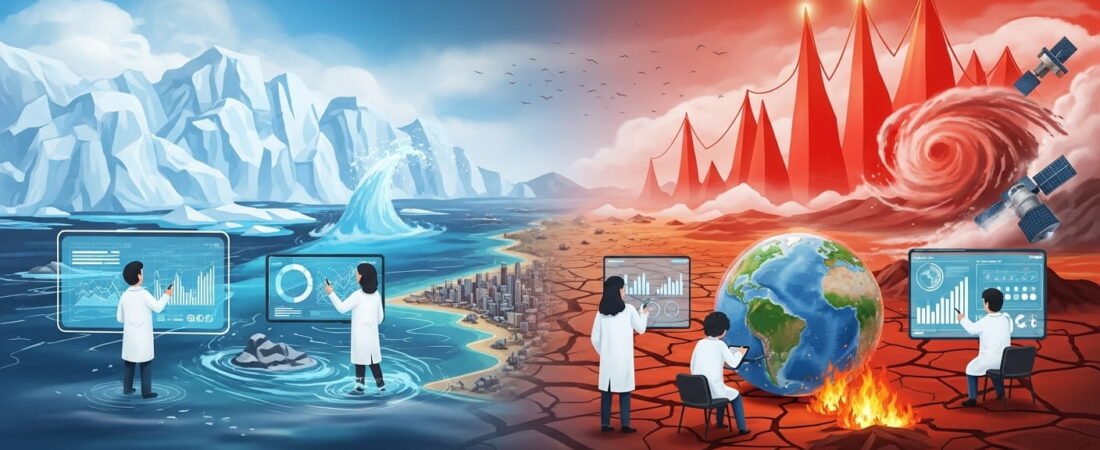
Climate change is no longer a distant environmental concern — it is a present-day global reality. In 2026, the conversation has shifted from “Is climate change real?” to “How fast is it accelerating, and what can we still control?” Scientists across the world are issuing stronger and more urgent warnings, emphasizing that the next few years will be critical in shaping the planet’s long-term future.
Over the past decade, global temperatures have consistently broken records. According to reports from the Intergovernmental Panel on Climate Change and the World Meteorological Organization, the planet is approaching key temperature thresholds that could trigger irreversible environmental changes. Therefore, climate discussions in 2026 are no longer theoretical — they are strategic and time-sensitive.
Moreover, climate change is not only about rising temperatures. It is directly linked to extreme weather events, prolonged droughts, melting glaciers, rising sea levels, and biodiversity loss. Consequently, countries across continents are experiencing floods, heatwaves, and storms at intensities that were once considered rare.
At the same time, scientists are highlighting a crucial point: while certain impacts are now unavoidable, the severity of future damage still depends on global action taken today. In other words, the window for meaningful intervention has narrowed — but it has not closed.
Interestingly, technological advancements are offering new climate solutions. Renewable energy expansion, carbon capture innovations, and sustainable agriculture systems are gaining traction. However, the pace of emission reduction remains a major concern. Despite international agreements like the Paris Agreement, global carbon emissions have not declined fast enough to meet the 1.5°C target.
From my perspective as someone closely observing global digital and technological trends, one clear pattern emerges: climate change is no longer just an environmental issue — it is an economic, political, technological, and social transformation driver. Businesses are adapting. Governments are restructuring policies. Consumers are shifting preferences.
In this article, we will explore what scientists are specifically warning about in 2026. We will analyze rising temperature thresholds, extreme weather intensification, ocean changes, food and water security risks, and the urgency of policy and technological solutions.
Because understanding the science today is the first step toward protecting tomorrow.
1. The 1.5°C Threshold: Why It Matters More Than Ever
One of the most critical warnings scientists continue to emphasize in 2026 is the 1.5°C global warming threshold above pre-industrial levels. The Intergovernmental Panel on Climate Change has repeatedly stated that exceeding this limit significantly increases the risk of severe climate impacts.
Moreover, recent climate data suggests that temporary breaches of 1.5°C have already occurred in certain months. While a short-term spike does not equal long-term failure, it signals accelerating warming trends.
Why does 1.5°C matter? Because beyond this level, the likelihood of extreme heatwaves, coral reef collapse, and Arctic ice loss rises dramatically. Furthermore, climate tipping points — such as the melting of Greenland’s ice sheet — could become irreversible.
Therefore, scientists are urging immediate emission reductions rather than delayed commitments.
2. Extreme Weather Is Becoming the New Normal
Another major warning in 2026 concerns the increasing frequency and intensity of extreme weather events. According to the World Meteorological Organization, heatwaves are lasting longer, storms are intensifying faster, and rainfall patterns are becoming unpredictable.
Consequently, cities worldwide are experiencing infrastructure strain. Flooding damages transportation networks, while droughts threaten agricultural productivity. Moreover, wildfire seasons are expanding due to prolonged dry conditions.
Importantly, scientists stress that climate change does not “cause” individual storms; rather, it amplifies their severity. Warmer oceans fuel stronger hurricanes, and hotter air holds more moisture, leading to heavier rainfall.
As a result, climate resilience planning has become a national priority for many governments.
3. Rising Sea Levels & Coastal Vulnerability
Sea levels continue to rise due to melting glaciers and thermal expansion of warming oceans. Coastal cities are increasingly vulnerable to storm surges and erosion.
The National Aeronautics and Space Administration (NASA) satellite data shows steady acceleration in sea-level rise over recent decades. Consequently, low-lying island nations face existential threats.
Moreover, saltwater intrusion into freshwater supplies is affecting agriculture and drinking water systems in coastal regions.
Therefore, scientists warn that without aggressive mitigation efforts, millions of people could face displacement in the coming decades.
4. Food & Water Security Under Pressure
Climate change is also disrupting global food systems. Irregular rainfall, prolonged droughts, and extreme heat directly impact crop yields.
Furthermore, freshwater availability is declining in many regions. Glacial melt initially increases river flow; however, once glaciers shrink significantly, long-term water supply becomes unstable.
As a result, scientists warn that food price volatility and water scarcity could intensify geopolitical tensions.
Importantly, adaptation strategies such as climate-resilient crops and efficient irrigation systems are being developed. However, implementation must accelerate.
5. Carbon Emissions & Policy Gaps
Despite global agreements like the Paris Agreement, emissions remain high. Scientists warn that current national pledges are insufficient to limit warming to safe levels.
Additionally, fossil fuel dependency remains strong in many economies. While renewable energy growth is impressive, it has not yet fully replaced carbon-intensive systems.
Therefore, experts emphasize the need for faster policy action, carbon pricing mechanisms, and clean technology investment.
6. Climate Tipping Points: The Irreversible Risks
Perhaps the most alarming warnings involve climate tipping points. These are thresholds beyond which environmental systems shift dramatically and permanently.
Examples include the Amazon rainforest transitioning into savanna or large-scale ice sheet collapse. Scientists caution that once triggered, these processes cannot be reversed within human timescales.
Consequently, preventing tipping points has become a central focus of climate research
Conclusion
When we examine the scientific warnings in 2026, one message stands out clearly: the climate crisis is accelerating, but action still matters. The 1.5°C threshold, extreme weather intensification, rising sea levels, and food system disruptions are not distant possibilities — they are unfolding realities.
However, alongside these warnings lies cautious optimism. Renewable energy adoption is expanding. Electric mobility is growing. Climate-focused innovation is accelerating. Governments and corporations are setting net-zero targets.
Yet, ambition alone is insufficient. Scientists consistently emphasize implementation. Promises must translate into measurable emission reductions.
Moreover, climate change is not only an environmental issue; it intersects with economics, healthcare, migration, and security. Therefore, solutions require collaboration across sectors.
From a strategic perspective, businesses that prioritize sustainability will likely gain long-term advantages. Similarly, individuals who adopt environmentally conscious practices contribute to broader systemic change.
Importantly, the scientific community is not predicting inevitable collapse. Rather, it is outlining risk scenarios based on current trajectories. The future remains influenced by collective decisions.
In conclusion, climate change in 2026 represents both a warning and a turning point. The science is clear. The risks are measurable. The technologies exist.
The real question is whether global action will match scientific urgency.
Because ultimately, the climate story of the next decade depends on choices made today.
Disclaimer:
This article is for informational and educational purposes only. Climate projections are based on current scientific research and may evolve as new data emerges.