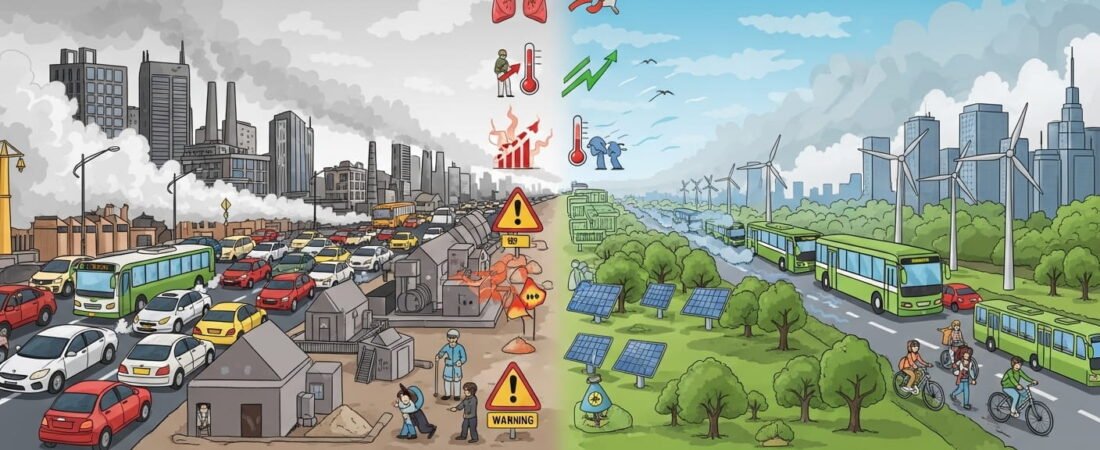


Introduction: Air Pollution in Indian Cities
Over the last decade, one issue has silently turned into a public health emergency across India — air pollution in Indian cities. Whether it is stepping out early morning in winter or checking the AQI app before leaving for work, polluted air has become a part of urban life. From metro cities like Delhi and Mumbai to rapidly growing cities like Lucknow and Kanpur, the air quality situation has become deeply concerning.
However, many people still consider pollution as just “winter smog” or a seasonal problem. In reality, it is a year-round crisis driven by rapid urbanization, industrial expansion, increasing vehicles, and poor waste management systems. According to global environmental reports, several Indian cities frequently appear in the list of the most polluted cities in the world. And while the headlines may shock us, the long-term impact on our lungs, heart, productivity, and even economy is far more alarming.
As someone who closely studies digital trends and public policy discussions, I believe we must move beyond awareness toward understanding. Because unless we understand the causes of air pollution in India, we cannot evaluate the solutions being proposed — nor can we contribute individually.
Moreover, air pollution is not just an environmental issue; it is a social and economic issue. It affects school attendance, increases healthcare expenses, reduces workforce productivity, and worsens inequality. Children, elderly individuals, outdoor workers, and people with respiratory conditions suffer the most.
Therefore, in this article, I will break down the major causes, real health and economic effects, and practical solutions — at government, industry, and individual levels. My goal is to present this topic in a structured, research-driven yet easy-to-understand format so that every reader can connect data with daily life.
Let us understand what is really polluting our cities — and what can truly clean them.
Major Causes of Air Pollution in Indian Cities
Air pollution does not come from a single source. Instead, it is the result of multiple overlapping factors.
1. Vehicular Emissions
Firstly, the rapid growth of private vehicles is one of the largest contributors. With rising incomes and urban expansion, the number of cars and two-wheelers has multiplied significantly. Cities like Delhi witness severe traffic congestion daily, leading to higher fuel combustion and emission of particulate matter (PM2.5 and PM10).
Additionally, older diesel vehicles and poorly maintained engines worsen the problem.
2. Industrial Emissions
Secondly, industries located near urban areas release harmful gases such as sulfur dioxide (SO₂), nitrogen oxides (NOx), and carbon monoxide. Industrial belts around cities like Kanpur contribute heavily to local pollution levels.
Although environmental regulations exist, weak enforcement and outdated technology often limit their effectiveness.
3. Construction Dust & Urban Development
Furthermore, large-scale infrastructure projects generate enormous dust. Uncovered construction materials, road digging, and demolition activities release particulate matter into the air. Rapid real estate growth without strict dust-control measures intensifies the issue.
4. Stubble Burning
Another major seasonal contributor is stubble burning in neighboring states, particularly around Punjab and Haryana. During winter, smoke from crop residue burning travels toward northern cities, significantly worsening AQI levels.
5. Waste Burning & Poor Garbage Management
Open burning of municipal waste releases toxic chemicals. In many urban slums and outskirts, waste burning remains a common disposal method due to lack of structured waste systems.
Therefore, the causes are interconnected — transport, industry, agriculture, and governance gaps collectively create polluted urban air.
Effects of Air Pollution on Health and Economy
Understanding the effects is equally important because pollution’s damage is often invisible at first.
1. Respiratory and Heart Diseases
Exposure to high AQI levels increases the risk of asthma, bronchitis, lung infections, and even heart disease. Cities like Delhi frequently report hazardous air quality during winter months.
Long-term exposure to PM2.5 can penetrate deep into the lungs and bloodstream, increasing stroke risk.
2. Impact on Children
Children are particularly vulnerable because their lungs are still developing. Poor air quality affects cognitive development, school attendance, and immunity levels.
3. Economic Productivity Loss
Moreover, rising healthcare costs and sick leaves reduce workforce productivity. Businesses lose working hours, and governments spend more on public health infrastructure.
4. Environmental Damage
Air pollution also damages crops, reduces soil fertility, and contributes to climate change. Pollutants like black carbon accelerate global warming.
Thus, pollution is not just a health problem — it is a development challenge.
Government Measures and Policy Interventions
In recent years, several initiatives have been introduced to control urban air pollution.
1. National Clean Air Programme (NCAP)
The Government of India launched the National Clean Air Programme to reduce particulate pollution levels across major cities. The program aims for significant PM reduction targets through city-level action plans.
2. BS-VI Emission Standards
India implemented Bharat Stage VI (BS-VI) emission norms to reduce vehicular pollution by introducing cleaner fuels and stricter engine standards.
3. Promotion of Electric Vehicles
Cities are promoting electric mobility to reduce fossil fuel dependency. Expansion of EV charging infrastructure is gradually increasing.
4. Odd-Even Traffic Scheme
The odd-even scheme in Delhi is a temporary measure to reduce traffic emissions during peak pollution periods.
However, while these policies are important, implementation consistency remains crucial.
Practical Solutions: What Can Be Done?
Solving air pollution requires collective effort.
1. Strengthening Public Transport
Investing in metro systems, electric buses, and affordable public transport can reduce private vehicle dependency.
2. Strict Industrial Monitoring
Real-time emission tracking and heavy penalties for violations can improve compliance.
3. Sustainable Urban Planning
Green belts, urban forests, and pollution-absorbing plants must be integrated into city planning.
4. Waste Management Reforms
Segregation at source and scientific waste disposal systems can eliminate open burning.
5. Individual Responsibility
Citizens can:
- Use carpooling and public transport
- Avoid burning waste
- Plant trees
- Support eco-friendly products
- Stay informed about AQI levels
Small behavioral shifts, when adopted collectively, create measurable impact.
Air pollution in Indian cities is complex, but it is not unsolvable. The real challenge lies not in lack of awareness — but in consistent action. If governance reforms, technological innovation, and citizen responsibility align together, cleaner air is achievable.
In the next section we will deeply analyze long-term sustainability strategies, future outlook, and a powerful conclusion that connects environmental responsibility with economic progress.
Conclusion: The Road Toward Cleaner Air in Indian Cities
Air pollution in Indian cities is not just a temporary environmental concern — it is a long-term structural challenge that demands sustained attention, policy discipline, and behavioral change. Over the years, cities like Delhi, Mumbai, and Kolkata have repeatedly recorded alarming AQI levels, especially during winter months. However, the issue is no longer limited to metro cities. Tier-2 and Tier-3 cities are also witnessing rising particulate matter levels due to urban expansion and industrial growth.
Therefore, the real question is not whether pollution exists — but whether we are ready to act consistently.
Why Long-Term Planning Matters
Firstly, air pollution control cannot succeed through seasonal emergency measures alone. While steps like the odd-even rule or temporary construction bans may reduce pollution briefly, sustainable improvement requires systemic transformation. Urban planning must prioritize green corridors, better traffic management, and clean energy adoption.
Moreover, environmental governance needs data-driven monitoring. Technology such as real-time emission tracking, satellite monitoring of crop burning, and AI-powered pollution analytics can significantly improve accountability. India’s implementation of the National Clean Air Programme is a positive step, but consistent evaluation and local-level execution will determine its long-term success.
The Role of Clean Energy Transition
Secondly, the shift toward renewable energy is crucial. Reducing coal dependency and promoting solar and wind power can lower industrial emissions significantly. India has already expanded its renewable capacity under initiatives aligned with global climate goals, but urban pollution control demands faster adoption.
Similarly, the push for electric mobility must continue. Expanding charging infrastructure, incentivizing EV purchases, and upgrading public transport fleets can gradually reduce vehicular emissions. However, clean electricity supply must accompany EV expansion to ensure true environmental benefit.
Agriculture & Regional Cooperation
Another important dimension is agricultural reform. Seasonal stubble burning in regions like Punjab and Haryana significantly impacts northern cities. While farmers face genuine economic constraints, long-term solutions require subsidized alternatives, machinery support, and crop diversification incentives.
Thus, cooperation between state governments becomes essential. Air pollution does not respect state boundaries; therefore, policy coordination must be regional rather than isolated.
Health Infrastructure & Public Awareness
Furthermore, healthcare preparedness must strengthen alongside prevention efforts. Increased respiratory clinics, early diagnosis programs, and awareness campaigns can reduce long-term damage. Schools should educate students about environmental responsibility, because behavioral change begins early.
From a societal perspective, pollution awareness should move beyond social media outrage. Citizens must adopt daily habits like using public transport, reducing energy consumption, and avoiding waste burning. Even corporate offices can promote work-from-home models during severe pollution phases to reduce traffic load.
Economic Growth vs Environmental Protection: A False Debate
Often, environmental regulation is seen as a barrier to economic growth. However, this is a short-sighted argument. In reality, clean air enhances productivity, reduces healthcare expenditure, and improves global investment perception. Cities with better environmental standards attract skilled professionals and global businesses more easily.
Therefore, sustainable development is not anti-growth — it is smart growth.
The Way Forward
Looking ahead, the solution lies in integration:
- Strong policy enforcement
- Technological innovation
- Green infrastructure investment
- Agricultural reform
- Citizen participation
When these elements work together, measurable improvement becomes achievable.
As a content writer deeply engaged with policy trends and digital transformation, I believe India stands at a critical turning point. The country has technological capability, policy frameworks, and growing environmental awareness. What is required now is consistency and accountability.
Clean air should not be a privilege available only during monsoon months — it should be a basic urban right.
If governance remains proactive, industries remain responsible, and citizens remain conscious, Indian cities can transition from pollution hotspots to sustainability models in the coming decade.
Disclaimer
This article is for informational and educational purposes only. While data and policy references are based on publicly available information, readers are encouraged to consult official environmental reports and government notifications for the latest updates.