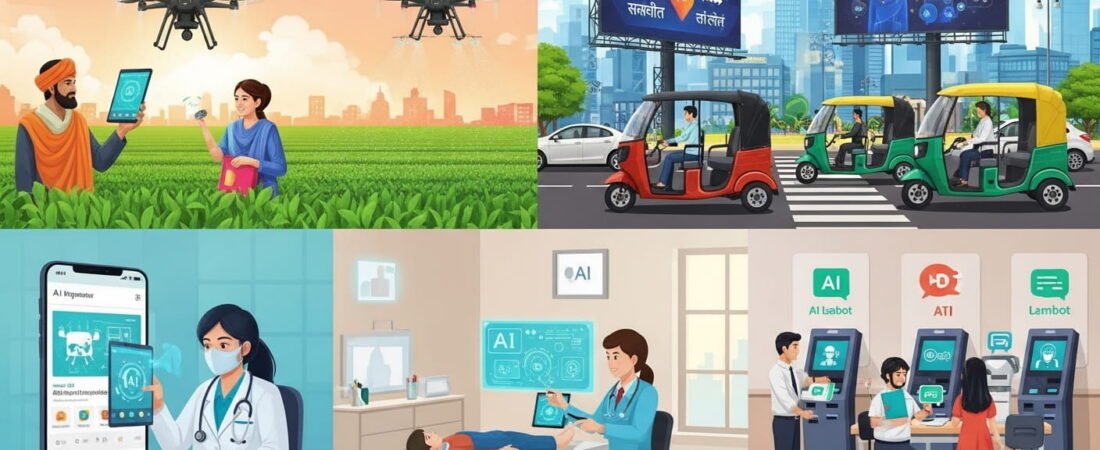


Introduction : How AI Is Changing Everyday Life
How AI Is Changing Everyday Life is transforming the way people work, learn, shop, access healthcare, and interact with digital services, making daily life faster, smarter, and more personalized than ever before
Artificial Intelligence is no longer a futuristic concept discussed only in tech conferences. In 2026, AI is quietly — and sometimes dramatically — reshaping everyday life in India. From the way we shop and study to how we manage money and access healthcare, AI-driven systems are becoming deeply integrated into daily routines.
Interestingly, India’s digital transformation journey has accelerated significantly over the past few years. With the growth of smartphones, affordable internet, UPI-based payments, and government-backed digital initiatives, the country has created fertile ground for AI adoption. Consequently, artificial intelligence is not limited to large tech companies; it is reaching small businesses, rural communities, and individual users.
For instance, when you receive personalized product recommendations on Amazon, use voice commands on Google Assistant, or complete instant payments through AI-enabled fraud detection systems, you are already interacting with AI. However, what makes 2026 different is the scale and depth of integration.
Moreover, Indian startups and global tech firms are actively building AI solutions tailored to local needs — whether it is multilingual chatbots for customer service, AI-driven crop advisory tools for farmers, or predictive analytics in banking. As a result, AI is becoming more inclusive and context-aware.
At the same time, concerns regarding data privacy, job displacement, and ethical AI governance are gaining attention. Therefore, while AI offers enormous potential, responsible implementation remains critical.
From my perspective as a digital marketing professional observing technology trends closely, one thing is clear: AI is no longer optional in India’s growth story. It is becoming the backbone of efficiency, personalization, and innovation. Whether you are a student preparing for exams, a professional working remotely, or a small business owner expanding online, AI is influencing your ecosystem.
In this article, I will explore how AI is transforming everyday life in India in 2026. We will examine its impact across banking, healthcare, education, retail, agriculture, and governance — and most importantly, understand what this means for the future of work and society.
Because AI is not just changing industries — it is changing habits.
1. AI in Banking & Digital Payments: Smarter, Faster, Safer
India’s banking sector has embraced AI aggressively. Institutions such as State Bank of India and private fintech platforms are using AI for fraud detection, credit scoring, and customer support automation.
For example, AI algorithms analyze transaction patterns in real time to detect suspicious activity. Consequently, digital payments through UPI platforms are safer and faster than ever before.
Moreover, AI-powered chatbots assist customers with account queries 24/7, reducing wait times. Therefore, banking is becoming more accessible, especially in semi-urban and rural regions.
However, data security and algorithmic bias remain concerns. As AI handles financial decisions, transparency and regulation become essential.
2. AI in Healthcare: Early Detection & Telemedicine Growth
Healthcare in India is also experiencing AI-driven transformation. Hospitals and startups are using AI for disease detection, diagnostic imaging, and predictive health analytics.
Organizations like All India Institute of Medical Sciences are exploring AI-based diagnostic support tools. These systems can analyze scans and flag abnormalities more quickly than manual methods.
Additionally, telemedicine platforms use AI chat interfaces to triage patient symptoms before connecting them to doctors. Consequently, healthcare access has improved in remote areas.
However, ethical considerations around patient data privacy remain critical. Therefore, balancing innovation with regulation is necessary.
3. AI in Education: Personalized Learning & Smart Classrooms
In 2026, AI-powered education platforms are tailoring learning experiences for Indian students. EdTech companies are using adaptive algorithms to analyze performance and recommend customized study plans.
For example, platforms like BYJU’S integrate AI to track learning gaps and improve retention strategies.
Moreover, AI-generated practice tests, automated grading systems, and multilingual tutoring support have enhanced accessibility.
As a result, learning is becoming more data-driven and personalized. However, digital divide issues still exist in certain rural areas.
4. AI in Retail & E-commerce: Hyper-Personalization
Retail and e-commerce platforms rely heavily on AI recommendation engines. Companies such as Flipkart use AI to predict consumer preferences and optimize supply chains.
Consequently, customers receive personalized suggestions, faster deliveries, and dynamic pricing options.
Additionally, AI chatbots handle customer queries, improving user experience.
However, data privacy awareness among consumers is increasing. Therefore, transparent data usage policies are becoming essential.
5. AI in Agriculture: Empowering Farmers
India’s agricultural sector is benefiting from AI-driven advisory systems. Predictive weather analytics and crop monitoring tools help farmers make informed decisions.
AI platforms analyze soil health, rainfall patterns, and market prices. As a result, farmers can optimize crop selection and reduce risk.
Moreover, government initiatives under Digital India are promoting digital literacy in rural regions.
Nevertheless, infrastructure and awareness gaps need continued focus.
6. AI in Governance & Public Services
AI is also improving public service delivery. From smart traffic management to digital grievance redressal systems, AI-driven analytics enhance urban planning.
Additionally, facial recognition systems and predictive policing tools are being tested in certain cities.
However, privacy and civil liberty concerns require careful oversight. Therefore, ethical governance frameworks must evolve alongside technological adoption.
Conclusion
In 2026, Artificial Intelligence is no longer a distant innovation in India — it is embedded in everyday life. From banking and healthcare to education and agriculture, AI is improving efficiency, personalization, and accessibility.
However, alongside convenience comes responsibility. Data protection, ethical AI deployment, and digital inclusivity must remain priorities. Without thoughtful regulation, rapid technological expansion can create unintended consequences.
Moreover, AI is reshaping the workforce. Routine tasks are increasingly automated, while demand for analytical, creative, and tech-driven roles is rising. Therefore, continuous learning and upskilling are becoming essential.
At the same time, India’s demographic advantage — a young, tech-savvy population — positions the country uniquely in the global AI race. Startups, government initiatives, and multinational collaborations are accelerating innovation.
Importantly, AI in India is not just about replacing human effort; it is about augmenting it. Doctors use AI as a diagnostic assistant. Teachers use AI to enhance learning. Bankers use AI to detect fraud. In each case, AI acts as a support system rather than a substitute.
In conclusion, AI Is Changing Everyday Life in India in subtle yet powerful ways. The 2026 update is clear: the shift is not coming — it is already here.
The key question now is not whether AI will shape India’s future, but how responsibly and inclusively it will do so.
Disclaimer: This article is for informational purposes only. AI adoption and regulatory developments may evolve based on government policies and technological advancements
Read More https://readnews.in/climate-change-in-2026-what-scientists-are-warning-the-world-about/